WHAT’S ON YOUR DESK?

So much of our reading and writing is serious I wanted to write something today that was more fun. I’m borrowing from the TV commercial question “What’s In Your Wallet?” for the title.

Even though I am no longer working full time, I do have two part time jobs – Pastor of Senior Adults at our church and Bible Teacher at Amarillo High School. Therefore, I have an office in the smallest bedroom in our home with a computer, printer, bookshelves, and desk.

On my desk I have three items that our male cat knocks off once or twice a day. He doesn’t hurt them, he just knocks them to floor so I can put them back. I don’t think he realizes they are important to me or he wouldn’t knock them off. All three meaningful reminders to me.

For many years the Disney character Goofy has been my favorite. I don’t collect Goofy figures, but my favorite sweatshirt of many years has his picture on the front. Goofy reminds me that we are not perfect and that we make mistakes, but also that we can and should have fun. Goofy is also the nickname I gave to one of our most loved staff members at Discovery Christian Church and who is still a great friend of mine – Bryan Sands. I didn’t give Bryan the nickname because he made mistakes or was incompetent; I gave him the nickname because he was and still is fun and loves life.

The little gold chest was given to me secretly by someone in my Sunday School Class at the end of our study “Treasures in the Bible.” We looked at seven passages in the Bible that used the word treasure to remind ourselves of some things we should value. The treasure chest reminds me that the Bible (Job 23:12), memories, people (Luke 2:19 and51), and the Gospel (II Corinthians 4:7) are all treasures. It also reminds me that some treasures are ill-gotten (Proverbs 10:2) and that there will be treasures in heaven (Matthew 6:19).

The Lego lion on my desk was a gift from my seven year old grandson who was and is really into Legos. One night he made three Lego figures and showed them to me. I asked him if I could have one for my desk. I told him that every time I saw it I would be reminded of him. He asked me which one I wanted and I immediately said the lion. Surprising to me, he smiled and gladly gave it to me. When he and his little brother come over I show it to him and he seems pleased.

I have a lot of others things on my desk and a lot of stuff in my office. I need my calendar, tissues, and scissors; and I use many of my files and books; but my goofy, my treasure chest, and my Lego lion are special!

What’s on your desk? Feel free to leave a comment below and/or share this post on Facebook.

ONE NAME – MANY DESIGNATIONS

While some understandably think Jesus has two names, the reality is he has only one – Jesus. Christ is not his last name, but it is one of the most used of many designations the Bible gives to him. If we were to write down all the designations for Jesus in the Bible (both Old and New Testaments) it would be a long list.

Two of the more prominent designations for Jesus in the New Testament are Son of God and Son of Man. In going to church as a youngster I learned that Son of God underscored the divinity of Jesus and Son of Man his humanity. While one of the basic Christian teachings about  Jesus is that he was fully God and fully man at the same time, Son of Man does not necessarily point to his humanity.

In the Gospels Son of Man is Jesus’ favorite self-designation. At that time Son of Man was not automatically thought of as a term of divinity, but was rather open to interpretation. Jesus used the term so that through his teaching and actions he could fill it with meaning. By the end of his ministry is was clear that his usage of the term was a claim to a special relationship with God similar to Son of God.

As important as Son of God and Son of Man are as designations for Jesus in the New Testament in terms of his identity, there are three other designations that have become my favorites. To me these three need to be held together in one’s personal understanding of who Jesus is.

The least used in the New Testament of these three is friend. And it is interesting that the label was first given to Jesus by his critics. Reflecting on their dissatisfaction with both John the Baptist and himself Jesus said, “For John came neither eating nor drinking and they say, ‘He has a demon.’ The Son of Man came eating and drinking, and they say, ‘Here is a glutton and a drunkard, a friend of tax collectors and sinners.’ But wisdom is proved right by her deeds” (Matthew 11:18 and 19).

In John 15:13-15 Jesus uses the word friends to describe his followers. In verse 13 he declares, “Greater love has no one than this: to lay down one’s life for one’s friends.” In verse 14 he adds a condition: “You are my friends if you do what I command.” The fullest explanation is in verse 15, “I no longer call you servants, because a servant does not know his master’s business. Instead, I have called you friends, for everything that I learned from my Father I have made known to you.”

In addition to friend, savior is also one of my favorite three designations for Jesus. While the term is used elsewhere as well, savior is prominent in the Christmas story as told by both Matthew and Luke. Savior speaks to the mission and work Jesus came to accomplish by going to the cross. Our friend is also our savior, and our savior is also our friend.

The third of my favorite designations for Jesus is lord. As a title lord suggests respect, but also authority. In many respects lord is synonymous with master. What is unique about lord as a title for Jesus is that we choose and accept him as Lord, he does not force it on us. Not only that, as our lord he does not use or take advantage of us; he wants only what is best for us.

Is it possible to hold these three designations together in our understanding of Jesus? I think so. All three are important and each contributes much to our relationship with him.

Feel free to leave a comment below and/or share this post.

photo credit: Diorama Sky <a href=”http://www.flickr.com/photos/27105072@N00/2920840552″>Jesus</a&gt; via <a href=”http://photopin.com”>photopin</a&gt; <a href=”https://creativecommons.org/licenses/by-nc-nd/2.0/”>(license)</a&gt;


DESERVE?

Reading through the Old Testament book of Deuteronomy last week, a couple of Moses’ comments to the children of Israel as they prepared to enter the Promised Land struck me.

The first was in 7:7 and 8 where he said, “The LORD did not set his heart on you and choose you because you were more numerous than other nations, for you were the smallest of all nations! Rather, it was simply that the LORD loves you.” Two chapters later, in looking forward to their entering the land, Moses cautioned them, “After the LORD your God has done this for you, don’t say in your hearts, ’The LORD has given us this land because we are such good people!’ It is not because you are so good” (9:4 and 5).

Even though the word deserve isn’t used by Moses, I was reminded of a memorable exchange between the Sheriff Little Bill and Will Munny in the movie “Unforgiven.” As Munny gets ready to shoot him, Little Bill says, “I don’t deserve this . . . to die like this. I was building a house.” To which Munny responds, “Deserve’s got nothin’ to do with it.”

Obviously it isn’t always the case, but Munny’s comment “Deserve’s got nothing to do with it” is true with regard to a lot of both the good and bad in life.

Intrigued by the word deserve, I looked up its usage in the Bible and was surprised by the number of times it occurs.

In Ecclesiastes 8:14 the teacher makes a similar observation to what Will Munny said: “There is something else meaningless that occurs on earth: the righteous who get what the wicked deserve, and the wicked who get what the righteous deserve.” Those familiar with the book of Job know he certainly would agree with that.

Both Mathew’s Gospel as well as Luke’s report the account of a Centurion asking Jesus to heal his sick servant. Matthew 8:9 reports the centurion telling Jesus, “Lord, I do not deserve to have you come under my roof” (and his faith is strong enough to affirm Jesus can heal his servant without doing so). Luke 7:4 and 5 tells about the same incident and how some of the elders of the Jews pleaded with Jesus, “This man [the centurion] deserves to have you do this, because he loves our nation and has built our synagogue.”

In our own experiences, and contrary to Will Munny’s take on it, I think we all would agree that sometimes – but not all the time — deserve does have something to do with it.

One of the two thieves crucified with Jesus seemed to get the most important point about Jesus’ death on the cross without fully understanding what he was saying. Speaking to the other thief who had insulted Jesus, he affirmed, “We are punished justly, for we are getting what our deeds deserve. But this man has done nothing wrong.”

One of the best known verses, as well as one we are most grateful for, is Psalm 103:10 where David tells us God “does not treat us as our sins deserve or repay us according to our iniquities.” And the reason God is able to do that is because of what Jesus did for us. It’s called grace.

Feel free to leave a comment below and/or share this post on Facebook.

photo credit: Visual Content <a href=”http://www.flickr.com/photos/143601516@N03/27571702173″>Legal Gavel</a> via <a href=”http://photopin.com”>photopin</a&gt; <a href=”https://creativecommons.org/licenses/by/2.0/”>(license)</a&gt;

DOUBLE STANDARDS

While exiting the freeway recently a driver on the road I was entering ignored the yield sign and almost hit me.  I wasn’t happy, but to my credit I did not honk my horn or glare at the other driver. As I moved into my lane behind him it occurred to me that on previous occasions I have done the exact same thing. I had to call myself on what was clearly a double standard. If he should have yielded to me (and he should have), then I also should have yielded at other times when the roles were reversed.

What reminded me of my inconsistency was a line in Gordon Smith’s short new book Teach Us to Pray, “it is so easy to spend our energy frustrated with others and wishing that others would change” (p. 15). His point is that we think about how others need to change, while we give ourselves a pass on the very same things. That’s what is called a double standard; and I confess I’m guilty. (By the way, if you are interested, Smith has an excellent chapter on “The Prayer of Confession” in the book.)

The greatest and most creative teaching about a double standard is given by Jesus in the Sermon on the Mount (Matthew 7:3 and 4): “And why worry about a speck in your friend’s eye when you have a log in your own? How can you think of saying to your friend, ‘Let me help you get rid of that speck in your eye,’ when you can’t see past the log in your own eye?” Again, I am guilty.

In the next chapter in his book Smith further convicted me with an unintended paraphrase of Jesus’ words, “We are so easily aware of the shortcomings of others rather than our own faults” (p. 22). Wouldn’t you agree that is pretty much what Jesus said?

For me, the most stinging part of Jesus’ teaching in Matthew 7:5 is the designation of the person with one standard for self and another for others a “hypocrite.” I think we can agree that Smith too is describing a hypocrite.

I do not believe either Jesus or Gordon Smith are suggesting we ignore the shortcomings or faults of others. The call is not to judge others while giving ourselves a pass. That’s a double standard and it isn’t appropriate.

Does my confession, Smith’s observations, and Jesus’ teaching say anything to you?

Feel free to leave a comment below and/or share this post on Facebook or other social media.

LOOKING AT WHOM?

In a post a few weeks ago I suggested that Revelation is the most difficult book in the Bible to interpret and understand. I still think that is true, but now as I come to the conclusion of a class I have been leading on the New Testament letter of Hebrews I’m thinking it is probably the second most difficult book in the New Testament.

As challenging as our study has been, we have gained a lot of knowledge as well as received much challenge and encouragement. I think challenge and encouragement for readers was the two primary goals of the author. And while parts of the letter are not easy to understand, other parts are crystal clear.

Today I’m thinking about Hebrews 12:1-3 and the writer’s image of the Christian life as running a race while keeping one’s eyes fixed on Jesus. We can get discouraged, question our faith, and get into all kinds of trouble when we take our eyes off Jesus. And often when we take our eyes off Jesus it is because we fix our eyes on someone else – usually a pastor or leader whom we look up to and admire.

The problem with fixing our eyes on another Christian is that no Christian measures up to Jesus. In spite of the highest motives and deepest faith, every Christian leader still has feet of clay. As committed to the Lord and their calling as they are, there are no perfect pastors.

This has always been the case, but in the recent months and weeks there seems to have been more cases and accusations of failures among Christian leaders than usual. Of course it grieves us, but it does not destroy our faith. Our faith is in Jesus and we are to keep our eyes on him.

The reality of the imperfection of pastors does not mean we shouldn’t respect, honor, and look up to our leaders. We should. Hebrews 13 gives two notes of instruction about how we are to view leaders.

Verse 13 tells readers to “Remember your leaders, who spoke the word of God to you. Consider the outcome of their way of life and imitate their faith.” My sense is that these leaders are primarily the ones who first presented the gospel to them and welcomed them to faith in Christ.

Verse 17 challenges readers to “Have confidence in your leaders and submit to their authority, because they keep watch over you as those who must give an account.” The leaders in this verse seem to be the ones who are currently overseeing things.

I think all pastors and church leaders should echo the words of the Apostle Paul, “Follow my example, as I follow the example of Christ” (I Corinthians 11:1). And we can more easily do that if we make sure we fix our eyes on Jesus and never take them off him.

Feel free to leave a comment below and/or share this post on Facebook or other social media.

photo credit: Damien Walmsley <a href=”http://www.flickr.com/photos/23766806@N00/34549305814″>20170618_Lily</a&gt; via <a href=”http://photopin.com”>photopin</a&gt; <a href=”https://creativecommons.org/licenses/by-nc/2.0/”>(license)</a&gt;

PRETENDING

Living close to and being involved with my two grandsons (ages 4 and 8) almost every day gives me the opportunity to do a lot of pretending. In recent weeks I’ve played the parts of Superheroes as well as a variety of “bad guys.” And it usually is a lot of fun.

Yesterday I read an interesting blog by Lance Witt entitled Image Management that sounds a lot like pretending to me. The difference, however, is that Image Management is neither a game nor fun. Witt’s primary intended audience is pastors and ministry leaders, but what he says is applicable to all Christians.

Those familiar with the New Testament no doubt are aware that Jesus’ primary issue with the Pharisees was what he called hypocrisy. They managed their images by pretending to be something they were not. What they projected to be on the outside by their actions did not match what they actually were on the inside.

Whether we are Christians or not, most of us know that pharisaism is not dead. As a matter of fact, chances are there is a little Pharisee inside all of us. To manage our images we sometimes struggle to let people know we really are not as good or as far along in our spiritual maturity as they think we are. Image management is not really management but deception.

By raising this subject I’m not suggesting that the thing for us to do is to become totally transparent with anyone and everyone in all our interactions with others. To refrain from pretending that we are better than we are, or that we have no problems, does not require us to publically “air our dirty laundry”.

I think what I am trying to say about this issue of image management or pretending is that we really need to work at being authentic. But again, to be authentic is not a call to total transparency.

When we give up pretending and become authentic we realize we have a new freedom. And that freedom opens the door and paves the way for us to actually make progress in what we want to become.

At the conclusion of his article Witt relates the honest words of a veteran Christian leader in his upper sixties: “The older I get the less concern I have with what I have or have not done and the more concern I have for what I have or have not become.” I’m in my late sixties and those are a couple of things I too would like to have less concern and more concern about.

By the way, pretending is not a bad thing — especially with grandchildren — as long everyone knows that we are just pretending.

Feel free to leave a comment below and/or share this post on Facebook or other social media.

License: <a href=”https://creativecommons.org/licenses/by-nc-nd/2.0/”>(license)</a&gt;

“BECOMING A FRIEND OF GOD”

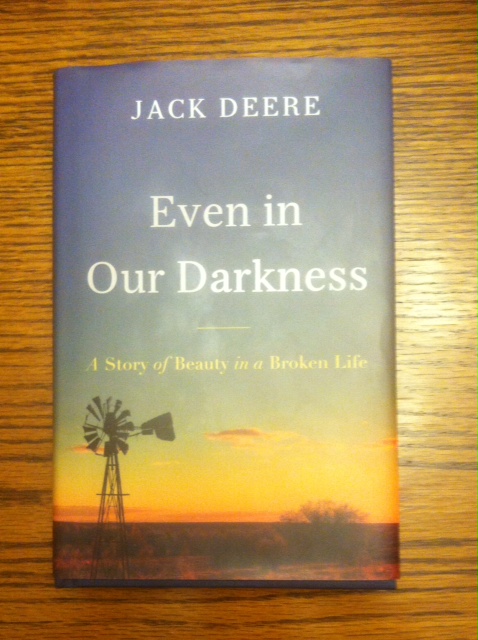
I don’t know when I have been more impacted by a book than I have been by Jack Deere’s memoir Even in Our Darkness: A Story of Beauty in a Broken Life. After the opening chapters, which are very short, it was difficult to put it down. I know reading his personal story touched me in a variety of ways, but I’m not sure how to describe my feelings. I’m surprised, sad, challenged, affirmed, convicted, and encouraged all at the same time.

I knew of John Deere through news stories and his books (that’s why I bought the book), but I had no idea of the ups and downs he has experienced. He calls this first book of his in almost 20 years “the unsanitized version of me becoming a friend of God.” That description compliments the book’s sub-title “A Story of Beauty in a Broken Life.”

What I have written so far may not sound like it, but I’m not necessarily recommending you read his story. He is a good writer, but Even in Our Darkness is not an easy read. It is real and raw, and as I read I was impressed with his transparency.

The darkness he writes about includes alcoholism, physical abuse, immorality, drug addiction, sexual abuse, attempted suicide, suicide, betrayal, and more. But as the book’s title suggests, this is a story of beauty even in the darkness of a broken life.

Let me share a few selected quotes that stimulated my thinking and will give you a taste of Deere’s account.

Following his dad’s funeral after he committed suicide: “We had neither church nor church friends to comfort us” (p. 34).

Commenting on some seminary faculty: “They traded blessed are the meek for blessed are the learned, and blessed are the poor in spirit for blessed are the pure in doctrine” (p. 120).

Speaking about his wife: “She tried to tell me how unhappy she was, I couldn’t hear her” (p. 136).

Assessing his spiritual state at one point: “The pursuit of knowledge had supplanted the pursuit of love, and a love of pleasure had replaced my hunger for the eternal things that can’t be seen” (p. 156).

His take on a congregation he served, “I tried to sympathize with their tiny frozen hearts” (p. 195).

This got my attention: “When the devil wants to send a message, he can always find a religious person to deliver it with perfect timing” (p228).

This is worth considering: “Anger circulates in our bodies as negative energy until we discharge it. We can carry it for years, punishing people we love, never understanding why” (p. 257).

His reflection on his life: “Almost nothing in my life has worked out like I thought it should. I thought as I grew older, I would grow more deserving of God’s love, not less” (pp. 269-70).

Thinking about his three children: “I had them too soon. I was too preoccupied with building my kingdom. I didn’t enjoy them as much as I could have” (p. 274).

Another reflection on his life: “When I lusted after material wealth, he turned my gaze toward eternity. When I sought large crowds, he brought me humility. When I tried to change my wife, he taught me how to love and understand her” (p. 278)

I read in order to learn, to be challenged, and to be encouraged as well as for other reasons. I won’t be ready for another book along the lines of this one for a while, but I am glad I read Deere’s gripping story of his life so far.

Feel free to leave a comment below and/or share this post on Facebook or other social media.

IT’S NOT EASY BEING GREEN?

Hopefully most readers will be familiar with Kermit the Frog and his famous song It’s Not Easy Being Green. Kermit is a favorite of Jim Henson’s Muppets for many. In his song he complains about being green, but concludes with a change of mind: “I am green and it’ll be fine, it’s beautiful! And I think it’s what I want to be.” In the title of this post I have turned his statement into a question.

Following a situation in which one of our grandsons was deeply disappointed and my attempt to help didn’t work, on the way home I asked myself, “Being a grandpa isn’t easy, is it?” As I reflected on what had just happened, I thought back to similar situations with our children and remembered “being a parent wasn’t and isn’t easy either.”

I stayed in Kermit mode and reminded myself of a lot of the roles and positions I have had that were not easy. Being a youth pastor was not easy, being the pastor of a small church was not easy, going to graduate school was not easy, being the founding pastor and a senior pastor was not easy, teaching at a college was not easy, and teaching a Bible class at our local high school this past year was not easy.

As I continued to think about these things I realized what a privilege all these roles and positions I have filled have been. If I had it to do it all over again I would not pass on any of the opportunities I have had. As odd as it may sound, part of the fulfillment and enjoyment I have experienced in these positions and roles has been because they were not easy, but it was worth it! If things were or are too easy, I can’t imagine they could or would be as satisfying.

With Kermit the Frog’s line “It’s Not Easy Being Green” in mind, and thinking about everything from being a grandpa to this past year’s teaching, a challenge from Jesus in the Sermon on the Mount came to mind. In Matthew 7:13 and 14 Jesus instructs us, “Don’t look for shortcuts to God. The market is flooded with surefire, easygoing formulas for a successful life that can be practiced in your spare time. Don’t fall for that stuff, even though crowds of people do. The way to life—to God!—is vigorous and requires total attention” (The Message). According to Jesus it’s not easy being a Christian, but it’s worth it!

I agree with Kermit (and borrowing a little from Popeye), “I am what I am and it’ll be fine, it’s beautiful! And I think it’s what I want to be.” I just want to do better and better with it. What about you?

Feel free to leave a comment below and/or share this post on Facebook or other social media.

MY MOM

Our pastor came up with an idea for something different for the message/sermon time on Mother’s Day weekend. He had a few staff members speak at each service telling how our mothers impacted our lives. The challenge was to do it in just five minutes. I was given the opportunity to speak in one service and below is what I said about my mom.

What I remember about my mom when I was very young is when we had friend chicken. Some of you may remember in those days when you bought chicken from the grocery story it included, in addition to the wings, also two backs.

For the longest time I thought the backs and wings were the best pieces because my mom always took them and left the other pieces to my dad, my brother, and me. I eventually realized that she took the pieces she did so we could have the legs, breasts, and thighs. My mom was unselfish.

The next thing I remember is that when I was in grade school my mom when to work in the school cafeteria. When my class and I came through the line she tried not to show me special favor, but it was so difficult for her. While in grade school I always was glad she was there. When I moved to junior high so did she; but to my shame I never was as glad to see her or as proud of her as I had been in grade school. But I do think she understood and never said anything to me about it.

While I was in grade school and junior high my dad was a problem drinker—every weekend he got drunk. But even though my mom would have been justified to kick him out, she never did. As I came to my teenage years my dad became a Christian and got his act together. I don’t think my mom ever regretted staying with him.

When I got my license and was able to buy my own used 53 Chevy my mom always had a message for me before I went out. She would say, “Just one word Bobby, be careful.” I knew what she meant, but I could not help saying, “Mom, be careful is two words.” Like many mothers, my mom worried a lot about both my older brother and me; and about my dad. I guess it goes with having that role.

When my dad was diagnosed with leukemia my mom took great care of him. He passed a few years before she did and took it hard. She lived in Ohio and we lived in California. When I think about it I’m sorry my children did not have more time around my parents, and I’m still sad I was not able to spend time with her during her last few years after my dad’s death.

My mom wasn’t perfect by any means, but she was a wonderful mother through whom God took care of me, loved me, and blessed me.

And on this Mother’s Day I again say thanks to her and to Him.

Feel free to leave a comment below and or share this post on Facebook or other social media.


DIFFERENT THINGS TO DIFFERENT PEOPLE

Some readers will remember the song “Happiness Is” in which after citing a variety of specifics for select people, the chorus affirms it is “Different things to different people.” Our own experience no doubt confirms the truth of the song’s premise.

I’ve been thinking about another word (in addition to happiness) that also means different things to different people. And not just one word, but several.

What brought it to mind was my quoting of Bruce Metzger in my Bible class and a student’s suggestion that he was one of my favorite professors. As I left the classroom I thought, “What a privilege it was for me to take several classes with such a brilliant, well-known, and gracious New Testament scholar.”

The word, of course, that means different things to different people today is privilege. I looked up a dictionary definition of privilege and read that it was “a special right or advantage granted or available only to a particular person or group of people.” That wasn’t my definition as I was using the word.

Then I looked up the word lucky and read that among other thing it means “fortunate, favored, charmed, fluky, and accidental.” In terms of those choices, I would agree I was fortunate (lucky) to study under Bruce Metzger—I don’t think it was accidental.

The third word, and perhaps the best word, to describe my experience with Bruce Metzger is one of the words included in defining lucky: blessed. One dictionary definition of blessing is “a special favor, mercy, or benefit.” My favorite definition suggests a blessing is “a favor or gift bestowed by God.”

As I understand and use the words I don’t think I have been or am privileged, but I consider many of the opportunities and experiences I have enjoyed as privileges. I wouldn’t necessarily use the word lucky to describe these things, but neither would I be upset if someone suggested I have been lucky. If pushed to be precise in describing my life experiences I would say I have been richly blessed by God and enjoyed many blessings from him.

The words privilege, privileged, lucky, blessed, and blessings all mean different things to different people. The point is that we all have been on the receiving end in many ways, haven’t we?

Feel free to leave a comment below and/or share this post on Facebook or other social media.