
MY MOM

Our pastor came up with an idea for something different for the message/sermon time on Mother’s Day weekend. He had a few staff members speak at each service telling how our mothers impacted our lives. The challenge was to do it in just five minutes. I was given the opportunity to speak in one service and below is what I said about my mom.

What I remember about my mom when I was very young is when we had friend chicken. Some of you may remember in those days when you bought chicken from the grocery story it included, in addition to the wings, also two backs.

For the longest time I thought the backs and wings were the best pieces because my mom always took them and left the other pieces to my dad, my brother, and me. I eventually realized that she took the pieces she did so we could have the legs, breasts, and thighs. My mom was unselfish.

The next thing I remember is that when I was in grade school my mom when to work in the school cafeteria. When my class and I came through the line she tried not to show me special favor, but it was so difficult for her. While in grade school I always was glad she was there. When I moved to junior high so did she; but to my shame I never was as glad to see her or as proud of her as I had been in grade school. But I do think she understood and never said anything to me about it.

While I was in grade school and junior high my dad was a problem drinker—every weekend he got drunk. But even though my mom would have been justified to kick him out, she never did. As I came to my teenage years my dad became a Christian and got his act together. I don’t think my mom ever regretted staying with him.

When I got my license and was able to buy my own used 53 Chevy my mom always had a message for me before I went out. She would say, “Just one word Bobby, be careful.” I knew what she meant, but I could not help saying, “Mom, be careful is two words.” Like many mothers, my mom worried a lot about both my older brother and me; and about my dad. I guess it goes with having that role.

When my dad was diagnosed with leukemia my mom took great care of him. He passed a few years before she did and took it hard. She lived in Ohio and we lived in California. When I think about it I’m sorry my children did not have more time around my parents, and I’m still sad I was not able to spend time with her during her last few years after my dad’s death.

My mom wasn’t perfect by any means, but she was a wonderful mother through whom God took care of me, loved me, and blessed me.

And on this Mother’s Day I again say thanks to her and to Him.

Feel free to leave a comment below and or share this post on Facebook or other social media.

 

DIFFERENT THINGS TO DIFFERENT PEOPLE

Some readers will remember the song “Happiness Is” in which after citing a variety of specifics for select people, the chorus affirms it is “Different things to different people.” Our own experience no doubt confirms the truth of the song’s premise.

I’ve been thinking about another word (in addition to happiness) that also means different things to different people. And not just one word, but several.

What brought it to mind was my quoting of Bruce Metzger in my Bible class and a student’s suggestion that he was one of my favorite professors. As I left the classroom I thought, “What a privilege it was for me to take several classes with such a brilliant, well-known, and gracious New Testament scholar.”

The word, of course, that means different things to different people today is privilege. I looked up a dictionary definition of privilege and read that it was “a special right or advantage granted or available only to a particular person or group of people.” That wasn’t my definition as I was using the word.

Then I looked up the word lucky and read that among other thing it means “fortunate, favored, charmed, fluky, and accidental.” In terms of those choices, I would agree I was fortunate (lucky) to study under Bruce Metzger—I don’t think it was accidental.

The third word, and perhaps the best word, to describe my experience with Bruce Metzger is one of the words included in defining lucky: blessed. One dictionary definition of blessing is “a special favor, mercy, or benefit.” My favorite definition suggests a blessing is “a favor or gift bestowed by God.”

As I understand and use the words I don’t think I have been or am privileged, but I consider many of the opportunities and experiences I have enjoyed as privileges. I wouldn’t necessarily use the word lucky to describe these things, but neither would I be upset if someone suggested I have been lucky. If pushed to be precise in describing my life experiences I would say I have been richly blessed by God and enjoyed many blessings from him.

The words privilege, privileged, lucky, blessed, and blessings all mean different things to different people. The point is that we all have been on the receiving end in many ways, haven’t we?

Feel free to leave a comment below and/or share this post on Facebook or other social media.



MOST DIFFICULT?

As I wrap up my first year of teaching the Bible at Amarillo High School I’ve been preparing what to say in coming to the Bible’s last book.

This will not be the first time I have taught about the Book of Revelation, but a couple of weeks ago I purchased a book about it that was highly recommended and offers some new insights and twists for me.

One thing the author said that got my attention is that Revelation is the most difficult book in the Bible to interpret and understand. You may or may not agree, but I certainly do; and if we survey the many different interpretations and understandings, we have to conclude it is complicated.

I could not agree more with what Gordon Fee and Douglas Stewart say in their book How to Read the Bible for All Its Worth: “It seems necessary to say at the outset no one should approach Revelation without a proper degree of humility!” Yet many interpreters think they have it all figured out.

My sense is that none of us knows exactly what everything in the book means, but I think that is part of the author’s intention. While written late in the first century, Revelation is meant to be read by and applicable to all believers until Jesus comes again. Contrary to what many suggest, I do not believe Revelation’s purpose is to give us a timeline and details of the future. Or as one author phrases it, an “advance DVD of the end of the world.”

Rather than telling us about when and what will happen at the end of time, the purpose of the book of Revelation is to give Christians warning, encouragement, hope, confidence, and comfort in whatever time they live.

One thing the book tells us is that things are bad and they are going to get worse. Revelation, of course, is not the only book in the Bible that tells us that.

A second thing the book tells us is that God is still on his throne. Even though it may appear that evil is dominating, God is still in charge.

Third, since God is still in charge, believers need to remain faithful. Even in the face of suffering and persecution, the call to followers of Jesus in Revelation is to maintain their faith.

Finally, the book of Revelation tells readers that in the end God wins. And if God wins, those who have remained faithful to the Lord also win.

Obviously there is a great deal more that can and should be said about the final book in the New Testament. But hopefully these few words about this sometimes strange and most difficult book will stimulate your thinking.

Feel free to leave a comment below and/or share this post on Facebook or other social media.

ON BEING DIFFERENT

When people say someone is different we only know what they mean by it if we know the context in which they say it. To be different can be a good thing, a bad thing, or neither. There are times when most of us don’t want to be different and other times when we do want to be different.

I recently watched a short video of John R.W. Stott talking about an important biblical teaching that he said we “tend to neglect.” If you don’t know who Stott is, he was a great evangelical leader and Bible teacher who was also the Rector of All Souls Church in London. He was also a prolific writer whose books are well worth having and reading. What he said we tend to neglect is the Bible’s call that the people of God be different.

He noted that in the book of Leviticus God told his people not to do as the Egyptians did or as the people in the land they were entering did. A favorite verse is Leviticus 11:45 where God says, “I am the LORD, who brought you up out of Egypt to be your God; therefore be holy, because I am holy.”

Without citing any specifics, he noted the frequent challenges of the prophets that the Israelites be different from their neighbors. The problem too often was, however, that God’s people were not different.

In moving to the New Testament Stott cited Jesus in the Sermon on the Mount in Matthew 6:5 cautioning his followers “not to be like the hypocrites.” In the preceding verses Jesus warns about the practice of the hypocrites who do good things “in front of others to be seen by them” and to “to be honored by others.”

The same basic call to be different is repeated and emphasized in the New Testament letters to those who are Christians. The best known instruction is from the Apostle Paul in Romans 12:2a, “Do not conform to the pattern of this world, but be transformed by the renewing of your mind.”

Stott didn’t mention the verse, but I also thought of I Peter 2:9 and what I’ve always considered a less than ideal rendering in the King James Version, “But ye are a chosen generation, a royal priesthood, an holy nation, a peculiar people; that ye should shew forth the praises of him who hath called you out of darkness into his marvelous light.” I guess technically Christians are to be peculiar, but I much prefer the word different.

How is this call to be different to be carried out by Christians today? If we are honest I think we must admit that on occasion Christians have done more harm than good in terms of their witness by being different. I don’t like the KJV word peculiar, but neither do I like the words odd or strange.

I’m not sure I fully understand what he was saying, but I go back to Jesus’ instructions to his followers in Matthew 10:16 when he told them, “I am sending you out like sheep among wolves. Therefore be as shrewd as snakes but as innocent as doves” (NIV). I also like the rendering in the New Living Translation, “So be as shrewd as snakes and harmless as doves,” as well as the Message, “Be as cunning as a snake, inoffensive as a dove.”

What I am suggesting is that as Christians we are to be different, but there is a way to be different that is not harmful to our witness, but is hopefully helpful. What do you think?

Feel free to leave a reply below and/or share this post on Facebook or other social media.

Photo License: <a href=”https://creativecommons.org/licenses/by/2.0/”>(license)</a&gt;


AN OLD CLICHÉ?

I was surprised to read a news story this morning in which a well-known Bible verse was called an “old cliché.” Neither the story nor the person who said it are important, but the designation got my attention.

The reference was to Proverbs 16:19, “Pride goes before destruction, a haughty spirit before a fall,” and was shortened to “pride comes before the fall.” The point of the verse was not changed, but already being a little irritated it was called an old cliché, I was even more irritated it was abbreviated.

I had an idea what a cliché is, but went ahead and looked up the definition to find it is “a phrase or opinion that is overused and betrays a lack of original thought.” Reading that description confirmed my irritation. I’m uneasy calling any verse in the Bible an opinion, overused, or lacking original thought.

To be fair, I’m not sure the person who cited the verse knew he was quoting the Bible. Whether he knew it was from the Bible or not, although the verse is not overused, it is obviously often used. That’s why he cited it and called it a cliché!

I certainly don’t believe what the Bible says is opinion, but there is much opinion about what it means. That’s why we study it, talk about it, and think about it. The fact that not all Christians agree on the meaning of what the Bible says does not mean that it is opinion. The Christian’s position on the Bible is that it is the Word of God and the challenge is to understand it and put it into practice.

Nor do I believe the Bible is overused. Some passages are cited more often than others, but that does not mean they are overused. If anything, for many of us the Bible is underused in our lives.

But does the Bible betray a lack of original thought? Yes and no. Because it is old and enduring, in one sense it does lack original thought. But to most people reading the Bible today it does not lack original thought. It is rather in many ways revolutionary with regard to our thinking and living. And the more we read, understand, and apply it to our lives the more revolutionary it is.

The Bible is often drawn upon without noting it as one’s source, and I’m always pleased to hear or read that it is being cited in public discussion. However, I wish the person quoting even a truncated version of Proverbs 16:19 would have acknowledged it was from the Bible rather than an old cliché.

We could all benefit from more citations of the Bible in our discussions, and especially from the wisdom of the book of Proverbs.

Feel free to leave a comment below and/or share this post on Facebook or other social media.
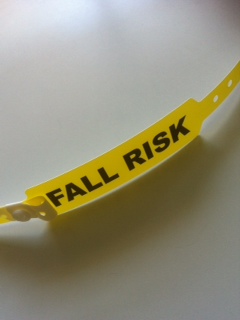
Photo License: <a href=”https://creativecommons.org/licenses/by-nc-nd/2.0/”>(license)</a&gt;

AT RISK?

When I visited the local hospital emergency room last week those who cared for me put a “FALL RISK” bracelet on my arm. They did that to alert others to keep an eye on me. And the reason was that I had fallen while walking our dogs and had sustained a head injury. (The good news is that even though I sustained a concussion and a shoulder injury, everything is going to be fine.)

As I thought about it I wondered if I had had the warning bracelet on earlier if I would have been more careful and not fallen. I don’t think so because I probably wouldn’t have taken it seriously and would have tripped anyway.

It also occurred to me as I looked at my bracelet that all of us are at risk of falling. At risk of physically falling while walking, but I have in mind what is called falling by sinning.

Christians speak of the Genesis account of the sin of Adam and Eve as “the fall.” By disobeying God they fell from their state of innocence to being guilty of sin. The Bible teaches that all of us have essentially done the same thing. The Apostle Paul is clear when he writes, “For all have sinned and fallen short of the glory of God” (Romans 3:23).

The Bible is filled with warnings and cautions about sin. One of my favorites is in I Corinthians 10:12 where Paul challenges his readers, “So, if you think you are standing firm, be careful that you don’t fall!” It sounds like overconfidence could be a problem for some of us – both falling with regard to sin as well as physically falling while walking.

I’m not planning on wearing my FALL RISK bracelet when I return to taking my turn walking the dogs, but I do think I will be much more careful. There is no guarantee I won’t fall, but I do think it will be less likely.

Nor do I think any of us should wear a FALL RISK bracelet to remind us and others that we are susceptible to falling by sinning. But in light of our failures – and please remember all have sinned and do sin – it might be helpful for us to remind ourselves that when it comes to sin we are all at risk to fall.

Even though we all have sinned, there is good news (often called the gospel). The Bible is clear that God loves us and has provided for our forgiveness through the sacrificial death of Jesus and our faith in him (see John 3:16). Following the bad news of Romans 3:23 about everyone having sinned, in verses 24 and 25a Paul gives the good news, “and all are justified freely by his grace through the redemption that came by Christ Jesus.  God presented Christ as a sacrifice of atonement, through the shedding of his blood—to be received by faith.” That is good news, isn’t it?

I wish I hadn’t fallen while walking the dogs, but my FALL RISK bracelet provoked some important thinking on my part. Feel free to leave a comment below and/or share this post on Facebook or other social media.

LESSON LEARNED – THE HARD WAY

When I teach the book of Proverbs I note the authors suggest there are two ways to learn: one is to listen to others, and the other is to “walk the thorny road of experience.” Obviously, the better way to learn is to listen to others, but that’s difficult for many. I used to think it was especially difficult for young people, but I no longer believe that. I’m 67 and still learning too many things the hard way.

Last week I was driving in an alley and texting a couple of people about getting together on Saturday. There were no other cars around and I wasn’t going very fast, but I did hit a wall with the left front side of my car. I was angry with and disappointed in myself; but worse than that, I was humiliated as I knew I would have to tell my wife and probably some others would find out as well.

I can’t count the number of times I have heard warnings on TV, radio, or others about not texting while driving. And I have read numerous reports about terrible accidents that resulted from texting and driving. Is it that I am a slow learner or do I think I am more highly skilled and a better driver than others are? Did I not hear the warnings or did I not think they applied to me?

I’m fairly confident that I have learned the lesson that I should not text while driving – regardless of where I am or how slowly I am driving. The downside is that I have learned the lesson the hard way, I have walked the thorny road of experience myself. You better believe I wish I had listened and put into practice the warnings I heard from others.

I am thankful that in learning this important lesson my car was not damaged any more than it is and that no other car or cars were involved. More than that, however, I am thankful no one was hurt or killed by my stupid action. Learning the lesson I learned could have been much costlier than it is going to be.

Consider this blog post a public service announcement: “a message in the public interest disseminated without charge, with the objective of raising awareness and changing public attitudes and behavior.” In other words, DON’T TEXT AND DRIVE AT THE SAME TIME! The better way to learn is to listen to others than to walk the thorny road of experience yourself.

Learning not to text while driving is not the only lesson you and I need to learn by listening to others. And learning not to do something is not the only lessons we need to learn from others; we also need to learn the positive things that we should be doing.

How are you doing when it comes to this idea of listening and learning from others? Are you open to hearing from others some warnings about what not to do as well as some encouragement to do some things you should do?

Feel free to leave a comment below but please do not scold or berate me for my stupidity — I already feel badly enough! Also feel free to share this post on Facebook or other social media – after all, it is a public service announcement.


OBSERVATIONS ABOUT “PAUL, APOSTLE OF CHRIST”

Since I still teach a variety of Bible classes, as well as have significant personal interest, I see most movies that are about the Bible and/or Christianity. Some are better than others, and some are simply bad — not just filling in details absent in the biblical account, but contradicting what is there. My take on “Paul, Apostle of Christ” is that it is pretty good.

The New Testament book of Acts ends with Paul waiting in Rome for two years for a hearing before Caesar (Acts 28:30 and 31). Primarily following reliable tradition, the movie picks up where the New Testament account ends and tells the story of the Apostle Paul from there through his martyrdom.

The tradition is that Paul was released at the end of the two years, did more evangelism and ministry, and was arrested again when persecution of Christians intensified under Nero. The movie is set during the time when Christians in Rome are being persecuted because Nero blamed them for the great fire in Rome (which most people thought Nero set himself).

In addition to Paul, key characters in the movie that are in the New Testament are Luke and the husband and wife team of Aquila and Priscilla. In the Bible Luke was a physician, a traveling companion with Paul in his ministry, and the author of the Gospel of Luke and the Acts of the Apostles. The movie gets it right in terms of Luke, except we do not know from the Bible if Luke visited Paul in prison as the movie depicts. Aquila and Priscilla are also in the New Testament book of Acts, and in the movie are the leaders of Christians in Rome staying out of sight so as not to be killed.

There are three key players in the movie’s story that are not mentioned in Acts or in tradition. A key figure is Mauritius, the overseer of the prison in which Paul and other Christians are being held, and his wife and daughter are also important to the story.

As would be necessary and expected in any biblically based film, some of the characters and story are no doubt fictional. While Aquila and Priscilla were certainly real in the book of Acts, we do not know if they had a role during Nero’s persecution of Christians in Rome. In the movie their leadership with the Christians in hiding is creative and contributes to the story.

The situation of Mauritius and his family also makes a significant contribution to the story being told. I won’t say more about the situation so as not to ruin it for readers who want to see the movie, but it is not hard to imagine something taking place like the movie shows.

If you are inclined to see “Paul, Apostle of Christ” I encourage you to do so. I think you will enjoy it as well as be challenged and encouraged. Remember, a lot of the movie is fiction, but a lot of it also is biblical and based on reliable tradition. At first I was disappointed because my expectations were too high, but I did enjoy it and am glad I went.

Feel free to leave a comment below and/or share this post on Facebook or other social media.


THIS GOT MY ATTENTION

Usually in these posts I write what I’m thinking, but in this one I want to do something out of the ordinary. Since it was Spring Break last week I did not go to school to teach; and because I had a Texas’ panhandle cold I stayed home all week. I took advantage of the opportunity and as I lay around I did a lot of reading rather than just watching TV. Some of what I read got my attention and I thought some readers might be challenged and encouraged as I was by a few quotes that got my attention.

An observation by Lois Tverberg in her book Reading the Bible with Rabbi Jesus about devotional reading: “A lot of us do Bible study microwave-style. We gulp down a prepackaged, presweetened devotion with a few slurps of coffee before heading off to work. Is it at all surprising when it’s bland and unmemorable, like a vending machine sandwich?” (p. 10)

Ouch! If our daily (or regular) devotional reading is basically just going through the motions, we probably need to give it a little more focus and energy to get out of it what we need.

A comment from John Dickson in his book A Doubter’s Guide to Jesus about the original sin in the Garden of Eden: “The story of Adam eating from the ‘tree of the knowledge of good and evil’ has nothing to do with gluttony and sensuality; it is all about man [sic] wanting to determine for himself, without God’s involvement, what the parameters of ‘good and evil’ should be” (p. 198).

Uh oh! It sounds like it is not up to us to decide what is right or wrong, but that determination is made by God and we need to accept it.

An interpretation of the Bible’s general teaching about submission from Dallas Willard in his book Life without Lack: “. . . submission is not assigning our responsibility to others, abandoning our own judgment, or allowing others to simply dictate to us. It is setting aside our own ideas as supreme and our own will as ultimate, freeing us from the burden of having our own way and of being all-wise in our own eyes” (p.64).

What? So submission is not a dirty word, nor is it exclusively intended for wives. It’s the opposite of thinking we know it all and are always right.

An assessment of Jonathan Edwards in article about him in Comment Magazine by Ray Pennings: “He had a whole-hearted desire to live life to God’s glory. His faith wasn’t simply a set of propositions; it had a comprehensive scope, impacting how he thought about food, vocation, old age, and relationships. A few years later a university friend helped me to put a finger on it when he described Edwards as ‘making natural things spiritual and spiritual things natural.’”

I think I would like to be more like Jonathan Edwards; and I have a ways to go in my growth as Christian.

A teaching from Jesus recorded in Mark 12:38-40, “Jesus also taught: ‘Beware of these teachers of religious law! For they like to parade around in flowing robes and receive respectful greetings as they walk in the marketplaces.  And how they love the seats of honor in the synagogues and the head table at banquets.  Yet they shamelessly cheat widows out of their property and then pretend to be pious by making long prayers in public. Because of this, they will be more severely punished’” (NLT).

My mom would have called this “showing off.” I wonder if any of us (especially pastors and preachers) ever act like those bad teachers of religious law.

Feel free to leave a comment below and/or share this post on Facebook or other social media.

PRIME TIME

The phrase Prime Time is used in a variety of contexts. Most prominent, perhaps, is the period of TV programming in the middle of the evening when the most people are watching. Many years ago when we purchased a timeshare (that we finally unloaded a couple of years ago) I noted that certain weeks of the year were designated Prime Time and the rules for using the timeshare those weeks were different.

For the past 45 years or so in my life, Prime Time has meant something different to me vocationally and personally. Prime Time for me comes once a year, but is not the same time each year — it varies. Nor is its length always the same for me; it’s sometimes longer and sometimes shorter. This year Prime Time began for me on Monday.

Prime Time for me each year is anywhere between seven and three weeks before and including Easter Sunday. It was Prime Time for me vocationally all these years because I was serving as a pastor. I never preached the same series, but I always preached a series of sermons leading up to Easter focusing on the life and ministry of Jesus, concluding with his resurrection.

But the reason the time leading up to Easter was Prime Time for me was not just because of the preaching. That period was Prime Time for me also because I always used it to focus on and cultivate my personal spiritual life. Preparing to preach was part of it, but certainly not all of it.

This year will be the fourth Easter since I retired after 30 years as pastor of Discovery Christian Church. It will be the fourth year I haven’t prepared a sermon series leading up to Easter or preached on Easter Sunday. And I am fine with that. Preparing sermons and preaching is a great joy and privilege, but it is also a lot of work!

I haven’t prepared a series or preached on Easter the past three years, but I have maintained my practice of focusing on and cultivating my personal spiritual life. I started reading the Gospel of Mark on Monday thinking if I read a chapter a day five days a week I would read about the crucifixion (chapter 15) on Good Friday and the resurrection (chapter 16) on Saturday or Sunday.

If you don’t have a plan for this year’s Prime Time I invite, challenge, and encourage you to join me. One chapter a day five days a week of Bible reading doesn’t take long, but can be very rewarding—especially during Prime Time!

(Let me know below if you are going to join me in reading Mark these three weeks and/or share this post on Facebook or other social media.)