JESUS, ANGER, AND US

Most people know Jesus was angry when He drove the money-changers out of the temple, but that’s not the only time the Bible tells us Jesus was angry. In a lesser known account in Mark 3:1-6 we are told about another time Jesus was angry.

On a Saturday Jesus went to the synagogue presumably to worship and there was a man there with a shriveled hand. There were also some critics of Jesus there to watch Him to see if He would heal on the Sabbath.

To make sure everyone present was on the same page so to speak, Jesus first asked the man with the shriveled hand to stand up in front of everyone. Then He asked a question, “Which is lawful on the Sabbath: to do good or to do evil, to save life or to kill?” But His critics remained silent. It was a question they could not answer. Of course it was lawful to do good on the Sabbath day! Given the opportunity, not to do good was in essence to do evil.

The primary thing I want us to see is what happened next: “He looked at them in anger and, deeply distressed at their stubborn hearts, said to the man, ‘Stretch out your hand.’  He stretched it out, and his hand was completely restored.” Some may be surprised at Jesus’ anger because they have always pictured Him as meek and gentle.  And He is, but that does not mean He could never be angry.

Jesus was angry with His critics because of their “stubborn hearts.” They didn’t care about the man with a shriveled hand.  They had no interest in him; they only saw the opportunity to accuse Jesus. Stubborn hearts can be calloused and cruel. What are we to make of Jesus anger?  Isn’t anger bad, isn’t it sinful? If Jesus was angry it is not always bad and sinful.

The Bible does teach that anger is dangerous and warns us about inappropriate anger. In Ephesians 4:26 the Apostle Paul quotes the Old Testament admonition “In your anger do not sin,” warning us that when angry we are more susceptible to sin.  And in I Corinthians the Apostle Paul tells us “Love is not easily angered.”

When we are angry usually our emotions are on edge; we are less restrained and more likely to say or do something we normally would not do or say. We know how dangerous anger can be because we have seen it in others, and more importantly–we have seen it in ourselves. Inappropriate and uncontrolled anger can hurt others and destroy our wider Christian testimony.

But anger is not always wrong. Ephesians 4:26 warns, “In your anger do not sin.”  But it does not say anger is sin. I Corinthians 13:5 says, “Love is not easily angered.”  But it does not say “love never gets angry.” The Bible warns us about anger, but it does not totally forbid anger. Jesus’ anger was appropriate and godly; and I think for two reasons.

First, because of what it was that made Him angry. There is a place for righteous anger. There are some things we should get mad about. But I find it so instructive to note all the times in Jesus’ ministry when He didn’t get angry when most of us would have. Jesus became angry at the right things.

The other reason Jesus’ anger was appropriate was because of what His anger led Him to do as well as what it did not result in. Anger is ok if we are angry for the right reason; and anger is ok as long as it results in our doing the right thing and not the wrong thing. Jesus gives us the example. Anger can motivate us and give us energy to make a positive difference.

Share this post if you think others would benefit and I welcome comments below.

photo credit: <a href=”http://www.flickr.com/photos/10506176@N07/3230475312″>Hulk (IMGP6543)</a> via <a href=”http://photopin.com”>photopin</a&gt; <a href=”https://creativecommons.org/licenses/by-nc-sa/2.0/”>(license)</a&gt;

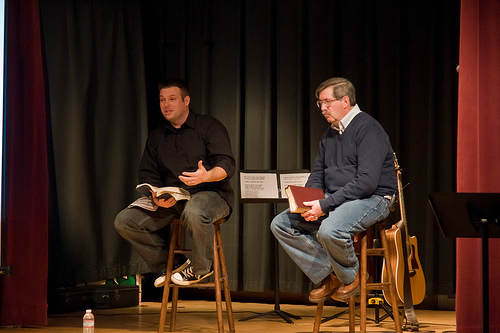
WHAT DO YOU LOOK FOR IN PREACHING?

Since I stepped down after 44 years of ministry 13 months ago Jan and I have visited numerous churches and listened to a variety of preachers. I’m guest preaching again this Sunday and am working on what I will say. Putting these two together, I’ve been thinking about this matter of preaching.

From the beginning of our church plant in Moreno Valley I had a commitment to significant Bible teaching. And to use the word significant suggests at least three things. One is that the teaching would be significant in terms of time allocation. Through the years I determined that while some preachers took more time, I would limit my Sunday messages to 30-35 minutes. A second aspect of significant Bible teaching for me is that we interpret the Bible in terms of its original intent and meaning. I never was a preacher who read a verse or passage from the Bible and then left it to say whatever I wanted to say. Bible teaching means teaching what the Bible says. Finally, the third aspect of significant Bible teaching is application. To teach the Bible in a Christian context is not only to consider its content, but also to apply it to life today.  Simply stated in the words of one author, “Interpretation is sterile without application.” Some of the messages I gave were more oriented to Bible content and its original meaning, and some were more focused on application for today, but every message had both.

Significant Bible teaching for me did not mean I could only preach straight through a book of the Bible or only preach what are called “expository sermons.” An expository sermon is teaching from one passage in the Bible and basically staying with that passage and going through it. In addition to expository sermons I often also preached what are called “topical sermons.” A topical teaching does not deal with only one passage of Scripture, but refers to and draws from a variety of passages that deal with the topic. In my mind to suggest the only kind of real preaching is expository preaching is to needlessly limit the preacher from dealing with many topics that should be addressed from throughout the Bible. 

In II Timothy 4:2 the Apostle Paul instructs Timothy, “Preach the word; be prepared in season and out of season; correct, rebuke and encourage—with great patience and careful instruction.” What a powerful challenge then as well as today!  Teaching the Bible is to include correction, rebuke, and encouragement, and it is to be done with patience and care. Some preachers go overboard with correction and rebuke with little encouragement while others are heavy on encouragement with little rebuke or correction. Some are lacking in patience and some are not careful enough in preparing and presenting biblical instruction. No two preachers do it exactly the same, but this verse gives all those who regularly teach the Bible some important guidelines.

What do you look for in preaching? Let us know below.

(This article is adapted from chapter 6 of my book A Pastor and the People: An inside Look through Letters.)

Photo Credit: <a href=”https://www.flickr.com/photos/57210543@N03/5359565302/”>Life Church Calvert</a> via <a href=”http://compfight.com”>Compfight</a&gt; <a href=”https://www.flickr.com/help/general/#147″>cc</a&gt;

HOW MUCH DO YOU THINK YOU KNOW?

I love the Old Testament book of Proverbs and have reread it every January for several years now. There is no way I could choose one favorite verse, but one I return to again and again is Proverbs 9:9. The New International Version renders this verse “Instruct the wise, and they will be wiser still; teach the righteous and they will add to their learning.” Here are four things I take from this verse.

I DON’T KNOW EVERYTHING. You may think that is obvious, but the truth is I sometimes come across as though I know a lot more than I do. I am finally learning that it is good to keep in mind that I don’t know everything; I don’t even know as much as I sometimes think I do.

Not only do I not know everything, I COULD BE WRONG. I don’t like to be wrong, but there have been plenty of times when I have been wrong. I’ve been wrong on some little things, and I have been wrong on some big things. It hasn’t always been easy for me to admit that I could be or was wrong.

If I could be wrong, then it follows that THE PERSON WHO DISAGREES WITH ME COULD BE RIGHT. If it is hard to admit you could be or were wrong, it’s probably even harder to admit that the person who disagreed with you was right.  I know people who have disagreed with me have been right at times.

In light of these first three revelations (that I’m sure surprise no one), I NEED TO KEEP LEARNING AND GROWING IN WISDOM. I don’t need to know everything, I don’t need to always be right, and it’s ok that someone who disagrees with me is right. What I need to do is to keep on learning and growing. And these four affirmations indicate at least some progress.

Going back to Proverbs 9:9, A CERTAIN LEVEL OF WISDOM IS ASSUMED if a person who is instructed will become even wiser. And A CERTAIN LEVEL OF RIGHTEOUSNESS IS ASSUMED if a person who is taught will learn more. I don’t think we can be too optimistic for those who think they know everything, who don’t think they are ever wrong and someone else could be right, or don’t realize they need to continue to learn and grow.

Proverbs 1:7 gives the theme of the book: “The fear of the LORD is the beginning of knowledge, but fools despise wisdom and instruction.” By “fear of the LORD” the Bible does not mean that we shrink back in terror from God, but rather that we acknowledge Him as Creator, worship Him as God, and submit to Him as Lord. That is a good beginning point, isn’t it? From there we can continue to welcome wisdom and instruction into our lives.

Share this post with others if you think it will encourage them and I welcome comments below.

photo credit: <a href=”http://www.flickr.com/photos/31167076@N07/5471047557″>question mark</a> via <a href=”http://photopin.com”>photopin</a&gt; <a href=”https://creativecommons.org/licenses/by-nc-nd/2.0/”>(license)</a&gt;

WHAT ARE YOU READING?

You may not get to read as much as you would like, but I’m sure you do your share of reading. Because of the nature of my work as a pastor I have always needed to read and had the time to do so. Since I stepped down from my last church just over a year ago I have had the opportunity to read even more than I did before. I want to highlight five books that may interest you and that you may want to get and read.

The title of one book got my attention: The Allure of Gentleness: Defending the Faith in the Manner of Jesus (2015, HarperOne). It was put together by Dallas Willard’s daughter (following his death) from his notes and lectures. The title not only got my attention, when I read it I was convicted. Willard challenges us as Christians not to “engage in debates and arguments with an antagonizing, arrogant spirit” (p. 2), but to “be characterized by gentleness” and humility.

A second book I am still reading is an older book (1998). I wanted to read it for a few years and finally ordered a used copy. It is entitled Amazing Grace: A Vocabulary of Faith (Riverhead Books) and is written by Kathleen Norris. (Yes, a woman!) It consists of some 80 brief chapters that deal with a variety of important words and phrases in Christianity often from a personal perspective. I am taking my time and savoring her selections.

For those interested in the Bible I am quite impressed with Gordon Fee and Douglas Stuart’s How to Read the Bible for All Its Worth (Zondervan). First published in 1981, I have the 2014 Fourth Edition. This book is required for one of the classes I teach at Hope International University and has informative chapters on every part of the Bible. It’s an excellent companion for Bible reading.

Last month I got Jesus: A Historical Portrait by Daniel Harrington (2007, St. Anthony Messenger Press). Harrington is a Roman Catholic priest and a professor of New Testament, but this short book is not complicated or too deep for you. “This book aims to state concisely and clearly for a general audience what many specialists in biblical research have learned and written about Jesus of Nazareth in recent years” (p.1). Just over 100 pages, this is an interesting overview of what the Gospels tell us about the life of Jesus.

Finally, if you have not read it, there is my book A Pastor and the People: An inside Look through Letters. You can read about it here https://bobmmink.com/book/.

Which of these books sounds the most interesting to you and might you get and read? What have you read recently you would suggest? Let me and other readers know in the comments below. And share this post if you think others would enjoy it.

photo credit: <a href=”http://www.flickr.com/photos/43188309@N00/15419801481″>Teach your baby to read</a> via <a href=”http://photopin.com”>photopin</a&gt; <a ref=”https://creativecommons.org/licenses/by/2.0/”>(license)</a&gt;

DO YOU UNDERSTAND SUFFERING?

I assume your answer to the question “Do you understand suffering?” is the same as mine. And that answer is “no.” But not knowing the answer doesn’t keep us from asking the question, does it?

Teaching my Old Testament survey class this week I had another opportunity to focus on the book of Job. The authors of one of our textbooks reminded me, “The book of Job is one of the greatest literary treasures in the world.” The authors of our other textbook note the book of Job does not offer an explanation of suffering but “a biblical perspective on suffering.”

The book of Job is about God responding to a challenge from the Accuser (Satan) that the only reason Job is righteous is because he is blessed. So God permits the accuser to bring great suffering on Job in terms of his family and his health.

In the midst of his suffering three of Job’s friends visit to comfort him and suggest he needs to confess and repent of whatever sin he has committed that has brought the suffering upon him. Job, however, insists he has not done anything to deserve his suffering and continually calls for an audience with God Himself.

The Accuser, Job’s friends, and Job himself all hold to what is variously called “The Retribution Principle,” “Contract Faith,” or “Traditional Theology.” This teaching basically says that if a person is good, obedient, and faithful he or she will be blessed by God. On the other hand, if a person is unfaithful, disobedient, and bad she or he will not be blessed but will suffer. In Job’s case his friends thought he had done something wrong and therefore he was suffering. But Job knew he had not done anything wrong and therefore did not deserve to suffer. That’s why he wanted an audience with God.

When God finally speaks to Job (chapter 38-41) He does not address Job’s suffering or respond to his complaint. Nor does He discuss the “Traditional Theology” held by the Accuser, Job’s friends, or Job. He doesn’t even tell Job why he is suffering. God emphasizes His great wisdom and power; and Job repents of wrongly accusing God of injustice. (I suggest you read at least chapter 38 and as much of the rest of the book as you can.)

I find it interesting that in the end God more than restored everything that had been taken from Job. Job proved that God was right and the Accuser was wrong. But Job was never told about the contest between his God and the Accuser.

Both the Old Testament and the New Testament suggest there is a link between the blessing of obedience as well as suffering as a result of sin. For example, see Exodus 19:3-6 and Galatians 6:7 and 8. Yet the why of suffering is often a mystery. Retribution theology is a valid principle, but it is not absolute.

It would be a mistake to assume that tough times are always the result of sin or that success is always the result of righteous living. We cannot simply assume that for ourselves or others.

If you think others would benefit from this post/article share it. I also welcome comments and/or questions below.

All photos on StockSnap fall under the Creative Commons CC0 license. 

THE PRIVILEGE OF BLESSING

On September 6 I read something in the devotional writing of Oswald Chambers that grabbed my attention and has stayed with me for over a month. In that day’s reading he observed “God rarely allows a person to see how great a blessing he is to others.” I’m not sure I totally agree with Chambers, but if he is correct, I am one of the rare ones who has had the privilege of seeing how God has used me to bless others.

After I stepped down from local church ministry in October of 2014 I put together a book entitled “A Pastor and the People: An inside Look through Letters.” The book included a variety of letters I received and wrote over the course of 44 years of ministry in four churches. Simply reading the letters gave me numerous snapshots of how God had used me to bless others. But even more than that, response to the book from people who were involved in those churches has given me even a greater sense.

Once the book came out I was contacted on Facebook by several who were in the church I served as Youth Minister from 1970 to 1975. The same thing happened with people who were a part of the church I served as Minister from 1975 to 1984. Many of the exchanges with people in those churches take me back 30 to 40 years!

A few weeks ago I was invited to write a letter of congratulations to a couple in the first church I served as a summer intern for their 65th wedding anniversary. What a privilege to be able to connect with that family after 44 years!

This past Sunday, on the anniversary of my last Sunday where I served as Senior Pastor for 30 years, I was invited back to preach. I was overwhelmed by the response of so many who welcomed Jan and me back, thanked us, told us they missed us, and assured us things were going well. Seeing how God has used someone to bless others is not as rare as Oswald Chambers suggests.

God has used me to bless others, but equally true and significant, He has also used others to bless me. The reality is that many of the ones He blessed through me are the same ones He used to bless me. And that mutual blessing continues.

Delighting in seeing how God has used me to bless others is not about self-promotion. I echo the declaration of Psalm 115:1, “Not to us, LORD, not to us but to your name be the glory because of your love and faithfulness.” For me to think I deserved the opportunities I have had, or to fail to thank those who gave them to me, would be an expression of both presumption and delusion.

I hope you have had and will have opportunities to be a blessing to others. And I pray God allows you to see how great a blessing you are.

Please share this if you think others would benefit from it and I welcome comments below. To read about “A Pastor and the People” click my book in the upper right hand corner. To receive email notification of these posts click follow.

photo credit: <a href=”http://www.flickr.com/photos/77197860@N00/2368230257″>Why I love my new Canon PowerShot G9, Part 4</a> via <a href=”http://photopin.com”>photopin</a&gt; <a href=”https://creativecommons.org/licenses/by/2.0/”>(license)</a&gt;

DID JESUS CONTRADICT HIMSELF?

At first reading two of Jesus’ statements in the Sermon on the Mount appear to contradict one another. In Matthew 5:14 He says to His followers, “You are the light of the world.” Then He adds in verse 16, “Let your light shine before others, that they may see your good deeds and glorify your Father in heaven.” Seems clear enough, doesn’t it?

Then in Matthew 6:1 Jesus instructs, “Be careful not to practice your righteousness in front of others to be seen by them. If you do you will have no reward from your Father in heaven.” Again, seems pretty clear, doesn’t it?

Which is it? Are we to let our lights shine before others so they may see our good deeds? Or are we not to do good deeds in front of others to be seen by them? It sounds like a contradiction, but it isn’t.

Jesus is talking about motive in both of these statements and the motive in each is not the same. The motive in the first instruction is to do good deeds with the idea that people will see our good deeds and glorify God. The motive Jesus forbids in the second instruction is doing good things to be seen by others. We aren’t to do good to draw attention to ourselves so people are impressed with us. As a matter of fact, if that is why we do good things, and we are seen by others, that’s the end of it. But we are to do good deeds and let our lights shine with the goal of pointing people to God.

In living the Christian life and doing good deeds we have to give attention to our motive. Why do we do what we do? Who do we want to get the attention? In a class years ago at Princeton Theological Seminary Professor Bruce Metzger gave us what I still think is sound advice: “When tempted to show, hide. When tempted to hide, show.” What do you think?

I welcome comments below. And if you think others would enjoy this challenge don’t hesitate to share it.

photo credit: <a href=”http://www.flickr.com/photos/34942348@N04/5992214519″>Whut?</a&gt; via <a href=”http://photopin.com”>photopin</a&gt; <a href=”https://creativecommons.org/licenses/by/2.0/”>(license)</a&gt;

I’VE BEEN EVERYWHERE

As I approach the one year anniversary of stepping down as Pastor of Discovery Christian Church I am reminded of the Johnny Cash song “I’ve Been Everywhere.” Jan and I have worshiped with a variety of churches across the country in Tennessee, Texas, and California. I have preached as a guest in several churches ranging from a cathedral where I wore a robe to a rented classroom where worshipers sat in chairs behind tables. Admittedly I have missed two Sundays—one when I was so sick I couldn’t get out of bed and one when we were traveling and couldn’t.

People go to church to worship the Lord, hear His Word, and spend time with His people. We were in churches with thousands and churches with under 30 and all sizes in between. There were a variety of styles of worship, and Jan and I were able to truly worship every place we have been. We discovered we could do that regardless of the setting, the style of music, or the preacher. Our worship has been enriched by the variety. But there were a few things I have been thinking about with regard to my own preferences.

Some worship leaders think you have to be standing to worship through singing. I love worship singing even when I am not singing, but standing the whole time doesn’t contribute to my worship. After standing for a song or two my preference would be to sit down and sing and stand again later. And all the songs don’t have to be loud and upbeat. We can worship meaningfully with a quieter and slower song—preferably sitting down.

Some pastors think they have to preach longer and say more than as a worshiper I want. I want significant Bible teaching applied to my life, but I don’t want to sit and listen for more than 40 minutes and would prefer around 30 minutes. Some Bible teachers try to cover too much material or in their teaching keep repeating themselves. It’s better to quit with the people wanting more than to go on and on with people wondering when it will be over.

Refreshments after worship add to the time of fellowship for those who are interested and enjoy them, but not everyone is interested in hanging around. Some people have plans and others simply do not like to eat what is provided or particularly want to talk. Invite worshipers to stay and eat, but don’t twist any arms as it may be counterproductive.

It has been a great 51 weeks for us and we have enjoyed everywhere we have been. We look forward with great anticipation to what the Lord has in store for us this next year in terms of where we worship and where I will be privileged to “guest preach.” And I’ll be fine if we stand the whole time we sing, if the pastor preaches for 40 minutes or more, and even if we are pressed to stay for donuts!

If you think others would enjoy this post share it and I welcome comments below.

photo credit: <a href=”http://www.flickr.com/photos/34444521@N03/5066198402″>cash2</a&gt; via <a href=”http://photopin.com”>photopin</a&gt; <a href=”https://creativecommons.org/licenses/by/2.0/”>(license)</a&gt;

DON’T YOU CARE?

In Mark 4:38 Jesus’ disciples asked Him a stunning question: “Don’t you care?” The actual question is longer than that, but that’s the gist of it. “Don’t you care?” is a question a lot of people still ask the Lord today. Even if you have never verbalized it, I’m sure there have been times when you thought it.

This question was asked in the evening following a day of teaching. In the midst of a trip crossing the lake a severe storm hit raising concern with the disciples that the boat might sink. But Jesus was asleep because He was tired. If you ever wonder if Jesus can identify with your fatigue the answer is yes.

Mark tells us they woke Jesus and asked, “Teacher, don’t you care if we drown?” There is a subtle tone of irritation and reproach in what they ask. Jesus’ response to their question was twofold. He calmed the storm and then asked, “Why are you so afraid?  Do you still have no faith?” Jesus wasn’t miffed that His disciples woke Him, He was disappointed they didn’t have more faith.

This exchange between Jesus and His disciples challenges us to think about our faith. It would be difficult to overstate the importance of faith in the Christian life. Hebrews 11:6 declares, “It is impossible to please God without faith.  Anyone who wants to come to him must believe that there is a God and that he rewards those who sincerely seek him” (NLT). Not only are we saved by faith, we are also to live by faith.

I don’t think it is a stretch to suggest that storms are a part of life. Pastor Rick Warren notes storms “are inevitable, they are unpredictable, and they are impartial.” Being a follower of Jesus does not guarantee cloudless skies or smooth sailing in life. We are going to face storms.

Just like the disciples we sometimes wonder if Jesus really cares. We feel Jesus has let us down. God does not always perform miracles to rescue us from life’s storms. And there are false teachers who wrongly suggest that if we had more faith we would be saved from the storms; we would be healed, our marriage would not fail, our financial woes would be resolved, or our child would not suffer.  But that is cruel and not what the Bible teaches. Real faith trusts God in the storm no matter what the outcome.

How much faith is enough? I’m not sure. Probably like you, I’m still trying to cultivate and increase my faith. One thing we might note, there is no record of Jesus ever telling anyone they had too much faith! I suspect you and I both could use a little more. The point is that Jesus can be trusted; especially in the storms of life.

I read that one day Mark Twain and a friend walked outside in the rain.  The friend asked him, “Do you think it will stop?” Twain responded, “It always does.” That’s true with any storm. You’ve got to go through it, but it’s not going to last forever.  Eventually, or ultimately, it will end.

Feel free to share this article with others and I welcome comments below.

(Adapted from Chapter 4 “Don’t You Care?” in my forthcoming book Questioning Jesus: Considering His Responses.)

photo credit: <a href=”http://www.flickr.com/photos/7557790@N03/7611121832″>ETWAS HOEHERES by Wolfgang Wildner</a> via <a href=”http://photopin.com”>photopin</a&gt; <a href=”https://creativecommons.org/licenses/by-sa/2.0/”>(license)</a&gt;

I DON’T KNOW

During my early years as a youth minister I didn’t have the maturity to say it, but it wasn’t long before I learned to answer some questions “I don’t know.” In the intervening years I have become more and more comfortable admitting I don’t know everything some people think I should know. No Christian, whether a leader or not, should be embarrassed to honestly say “I don’t know.”

While this kind of honesty is appropriate in general, I especially have in mind biblical and theological questions. I was reminded of this recently when I read a bold statement by Eugene Peterson, “Sometimes the Bible raises more questions than it answers!” That’s true, and it should not surprise us. After all, we believe the Bible is the Word of God. We will never completely understand God. Theologians call it the incomprehensibility of God.

I always smile when I am reminded of the standard graduate theological degree many Christian leaders go to seminary to earn. It’s called a Master of Divinity. If there ever was an example of an oxymoron in terms of graduate degrees, the Master of Divinity is it. To those who think they have mastered God and completely understand Him I recommend an old book by J.B. Phillips first published in 1952 entitled Your God Is too Small.

A couple of verses, one each from the Old and New Testaments, lend support to what I am saying. Deuteronomy 29:29a affirms, “The secret things belong to the LORD our God,” and II Peter 3:16b observes about the Apostle Paul’s writing, “His letters contain some things that are hard to understand.”

I am not suggesting there is not a great deal we can and do understand about God and the Bible. Nor am I implying we should not have firm convictions about what is clear in God’s revelation to us. I am simply saying that we don’t know everything we would like to know and it seems obvious to me that we should admit it when that is the case. Not only that, I have always thought that when we admit we don’t know something it adds credibility to the things we say we do know.

A quote attributed to Mark Twain makes a lot of sense to me: “It ain’t those parts of the Bible that I can’t understand that bother me, it is the parts that I do understand.” We should certainly put into practice those parts of the Bible we do understand and continue wrestling with and thinking about those parts we don’t understand. And we should be willing to say “I don’t know.”

By the way, I not only have a Master of Divinity, I also have a Master of Theology and a Master of Arts in Religion. If you have any questions don’t hesitate to ask. And don’t be surprised if my response is “I don’t know.”

If you think others would enjoy this go ahead and share it. And I welcome comments below.

photo credit: <a href=”http://www.flickr.com/photos/8342778@N08/9515176520″>IMG_1044-2.jpg</a&gt; via <a href=”http://photopin.com”>photopin</a&gt; <a href=”https://creativecommons.org/licenses/by-sa/2.0/”>(license)</a&gt;