ARE YOU KING OF THE JEWS?

What I hope will be a meaningful read as we come to Thursday and Friday of Holy Week this year.

The most dramatic and consequential questioning of Jesus took place during the hearings and trials He went through prior to His crucifixion. Actors have tried to capture the drama in a multitude of plays and movies ranging from small church youth-led Good Friday services to the big screen of Hollywood.

But the consequences were more important than the drama. For Jesus it meant His death on the cross. Of course He knew the reason He came was to die, but His prayer in the Garden of Gethsemane gives us insight into His inner struggle. In addition, the consequence of His death was an opportunity for us to have life, through the forgiveness of our sin and restoration of our status as children of God.

Context and Setting

The accounts of the night of Jesus’ arrest and trials, all the way through His resurrection and ascension, are in many respects the most difficult to harmonize in the Gospels. The trials before His crucifixion and His appearances after His resurrection are most challenging. John’s account of Jesus before Pilate is the most complete of the four with Matthew and Mark being in the most agreement about the entire ordeal. I suggest reading and studying one account at a time and not investing a great deal of time and energy in trying to harmonize everything.

In terms of the questioning of Jesus prior to His crucifixion, the questioning from Pilate was the final stage. Prior to appearing before Pilate Jesus went before Jewish authorities two or three times. It seems clear Jesus was first questioned informally and then later taken before the Sanhedrin (the formal Jewish council). Only John tells us that Jesus was taken first to Annas, the father-in-law of the high priest Caiaphas (18:13). After that He was taken “to Caiaphas the high priest, where the scribes and the elders had gathered” (Matthew 26:57).

Early the next morning the night’s questionings came to a climax. This exchange is also the high point of all that had transpired between Jesus and His critics during His final week.

The Jewish leaders were looking for evidence to charge Jesus so they could put Him to death. In the first part of the “hearing” they couldn’t get two witnesses to agree. Finally, two agreed about Jesus saying He was able to destroy the temple and rebuild it in three days. Yet even with the high priest challenging Him to respond, Jesus remained silent.

Finally, exasperated, the high priest challenged Him: “I charge you under oath by the living God: Tell us if you are the Messiah of God” (Matthew 26:63). By the things He had done and said, especially in recent days, Jesus had given enough reason for the high priest to ask the question. Matthew, Mark, and Luke all report Jesus’ answer a little differently; Matthew has Him saying, “You have said so” (Matthew 26:64a). As we will see later, this is very similar to the response Jesus would soon give to Pilate.

But the answer that brought everything to a head was what Jesus said next: “But I say to all of you: From now on you will see the Son of Man sitting at the right hand of the Mighty One and coming on the clouds of heaven” (Matthew 26:64b). It was a bold statement claiming a special relationship with God no human being could have. The high priest tore his clothes (a sign that blasphemy had been committed) and said, “He has spoken blasphemy! Why do we need any more witnesses? Look, now you have heard the blasphemy. What do you think?” (Matthew 26:65 and 66a). And all agreed Jesus was worthy of death.

The final note of context and setting is Matthew 27:1 and 2: “Early in the morning, all the chief priests and the elders of the people made their plans how to have Jesus executed. So they bound him, led him away and handed him over to Pilate the governor.”

Questioning Jesus and Considering His Responses

Since John’s account of Jesus before Pilate gives the most detail, we will use it in this part of our study. Pilate began the proceedings by asking the Jewish leaders what charges they were bringing against Jesus (18:29). These enemies of Jesus knew they didn’t have a charge that would stand up in the Roman court so their response was Jesus was a criminal. In the first of several efforts to remove himself from the situation, Pilate told them, “Take him yourselves and judge him by your own law” (18:31).

The leaders’ response was they did not have the right to execute anyone; this was the very reason they had taken Jesus to Pilate. The Roman government did not permit its subjects to convict and carry out the death penalty. That was in the hands of the local governor. The leaders’ problem was compounded in that blasphemy was a serious infraction for the Jews, but meant nothing to the Romans.

It was at this point that Pilate asked the key question. The question is identical in all four Gospels: “Are you the king of the Jews?” (Matthew 27:11; Mark 15:2; Luke 23:3; and John 18:33). The question is identical, but the recorded response of Jesus is not. Matthew, Mark, and Luke all have Jesus responding, “You have said so,” the same response Jesus had given earlier to the high priest. R.T. France notes this answer “is a qualified affirmative,” indicating yes to the question, but not in accordance with the meaning the questioner has in mind.20 In other words, Jesus was agreeing He was indeed a king, but not in the way Pilate was using the word.

John’s fuller account of the exchange between Jesus and Pilate bears out France’s interpretation of Jesus’ answer recorded in the other Gospels. John tells us Jesus’ responded with a question: “Is that your own idea, or did others talk to you about me?” (18:34). It seems pretty clear that Jesus’ accusers had set Him up ahead of time. Pilate responded, “Am I a Jew? Your own people and chief priests handed you over to me. What is it you have done?” (18:35)

The final part of Jesus’ response to Pilate is one of His best-known sayings: “My kingdom is not of this world. If it were, my servants would fight to prevent my arrest by the Jewish leaders. But now my kingdom is from another place” (18:36). He had a kingdom, but it was not like the world’s kingdoms. If it was His disciples would have fought for Him.

Only Luke tells us that at this point in the proceedings Pilate learned Jesus was from Galilee and sent Him to Herod (Luke 26:6:12). This was the second attempt by Pilate to opt out of dealing with Jesus. But Herod sent Him back to Pilate.

Pilate made two more attempts to get out of dealing with the charges and requests the Jewish leaders brought to him about Jesus. He brought up the custom of releasing a prisoner at the time of Passover and offered to release “the king of the Jews” (John 18:39). Instead they chose Barabbas. Pilate also repeated his view that Jesus was innocent by declaring, “I find no basis for a charge against him” (John 19:6b).

In John’s account Pilate also continued questioning Jesus, concluding with, “Don’t you realize I have power either to free you or to crucify you?” (19:10). In Jesus’ final words to Pilate He gave another bold and powerful answer: “You would have no power over me if it were not given to you from above. Therefore, the one who handed me over to you is guilty of a greater sin” (19:11). Jesus told Pilate the only power he had over Him was given to him by God. And even though Caiaphas (probably) was guiltier, Pilate was also guilty.

Wrap Up

Pilate was a conflicted leader who tried hard, but not hard enough. John tells us, “From then on Pilate tried to set Jesus free” (19:12a). But the Jewish leaders would not accept it. The final straw for Pilate was no doubt what these leaders had in mind when they first took Jesus to him. They told Pilate, “If you let this man go, you are no friend of Caesar. Anyone who claims to be a king opposes Caesar” (19:12b).

Even though I have known the account since I was child, and have heard it more times than I can count, I think one of the saddest verses in the Bible is John 19:16: “Finally Pilate handed him to them to be crucified.”

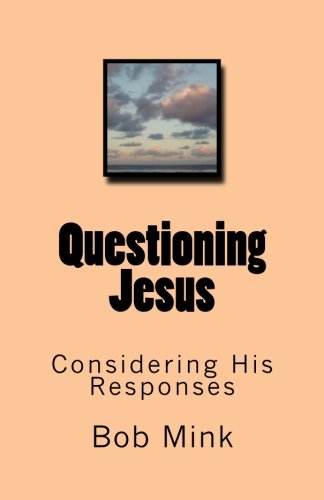
This is chapter 13 of my book Questioning Jesus: Considering His Responses. To learn more about the book, read endorsements, or order the book go to Amazon’s website:

http://www.amazon.com/Questioning-Jesus-Considering-His-Responses/dp/1517785855/ref=sr_1_3?ie=UTF8&qid=1455234806&sr=8-3&keywords=Questioning+Jesus

Feel free to share this post on social media and/or leave a comment below.

photo credit:

<a href=”http://www.flickr.com/photos/60532802@N07/5613765246“>Scourged 08</a> via <a href=”http://photopin.com“>photopin</a> <a href=”https://creativecommons.org/licenses/by/2.0/“>(license)</a>


WHAT ARE YOU ASKING FOR?

As we come to Palm Sunday, Good Friday, and Easter these next two weeks I have been reading Mark’s account of Jesus’ final trip to Jerusalem. Even though I have read it many times before, as well as preached from it, I was struck by the account of Bartimaeus in Mark 10:46-52.

Verse 46 tells us as Jesus, His disciples, and a large crowd were leaving Jericho there was a blind man named Bartimaeus “sitting by the roadside begging.” Like today, it was not uncommon in Jesus’ day for people to be at high traffic areas begging. What was uncommon was what Bartimaeus shouted when he heard that Jesus was coming by: “Jesus, Son of David, have mercy on me!” The title he used for Jesus indicated his high regard for Him.

Verse 47 tells us many in the crowd scolded and quieted him, but that only caused him to shout even louder. Hearing the shouting, Jesus stopped and instructed those with him to “Call him.” Now those who were previously quieting him began telling him to cheer up and get on his feet because Jesus was calling him. And Bartimaeus did not need to be told twice as he threw his cloak aside, jumped up, and went to Jesus.

Jesus’ question in verse 51 is what struck me: “What do you want me to do for you?” In his initial calls to Jesus he asked for mercy, but in response to Jesus’ question he was specific: “Rabbi, I want to see.” Then Jesus granted his request telling him in verse 52, “Go, your faith has healed you.” The account concludes with “Immediately he received his sight and followed along the road.”

The fact that Bartimaeus is one of the very few named that Jesus helped suggests to me this is an important account. I note the boldness, persistence, responsiveness, openness, and faith of Bartimaeus. And once he received his sight, Bartimaeus followed Jesus.

Hopefully you and I know who Jesus was and is even more clearly than Bartimaeus did. We know Him as Jesus; we know what the title Son of David means; and we look to Him as our teacher (Rabbi). We also know Him as our Savior and Lord.

I’ve been looking to Bartimaeus as an example and encouragement for me in prayer. In addition to the elements of praise and thanksgiving, one of my general requests lately has been for mercy. The Bible is clear that God is a God of mercy and I know that I need His mercy even when I am not aware of my need.

I am most intrigued by Jesus’ question: “What do you want me to do for you?” In his book Jesus: A Pilgrimage James Martin makes three statements that challenge me to do some serious thinking. First he suggests “Jesus sees something liberating in identifying and naming our desires.” Two paragraphs later he says “Notice that Jesus does not say, ‘Bartimaeus, just accept the way things are’.” Then the takeaway for me, “when we stand before God in prayer we should feel comfortable expressing our longings.”

In addition to asking the Lord for mercy, I also have a few specifics; in your prayers today what are you asking for?

Feel free to share your comments below and share these thoughts on social media.

photo credit: <a href=”http://www.flickr.com/photos/16210667@N02/16404623337″>Saying a little prayer for you</a> via <a href=”http://photopin.com”>photopin</a&gt; <a href=”https://creativecommons.org/licenses/by-nd/2.0/”>(license)</a&gt;


ON TURNING 65

Today I turn 65; and in all honesty I don’t find it unsettling at all. Since I have known it was coming it doesn’t take me by surprise. I went on Medicare March 1 (although I haven’t used it yet) and began taking social security last year. Here are some of my thoughts as I come to this milestone.

I DON’T FEEL OR ACT OLD

Of course I realize I am not 40, 50, or even 60; but I don’t really feel that old. My health is pretty good and I remain active regularly playing golf and going to the Fitness Center two or three times a week. It can be embarrassing to my family, but I don’t act old either. If you could see me playing with my grandsons (ages 6 and 2) or be in one of the classes I teach at Hope International University you would agree I don’t act old. My wife and daughter sometimes chastise me, and I do periodically have to remind myself I am a professor, but I want to have fun and be fun.

I’m 65 and on Medicare, but I don’t feel or act old.

I’M NOT FINISHED GROWING

In terms of continuing to learn and spiritually mature I am still making progress. I still read a lot of books, magazines, and online newsletters. Teaching History and Literature of Ancient Israel at Hope has been a real plus. Most of my graduate work was in New Testament and teaching this course has made the Old Testament more interesting and important to me.

Since I am no longer regularly preparing to preach, my Bible reading has become more meaningful and rewarding. In connection with my Bible reading I still often consult commentaries to see what others have to say, but I’m applying what I read to my own life more than ever before. And the devotional books I read not only challenge my thinking, but also the way I live as a follower of Jesus.

I’m 65 and sort of retired, but I’m not finished growing.

I’M NOT THROUGH BEING USED

I was a youth minister or pastor for 44 years before I stepped down after 30 years at my last church in October of 2014. But that does not mean God is no longer using me in His service. Being an adjunct professor of biblical studies gives me a great opportunity to impact and influence first year college students. I also get to “guest” preach some Sundays. And I continue to write as well. As you may or may not know, I have published two books in the last year. (A Pastor and the People: An inside Look through Letters and Questioning Jesus: Considering His Responses are both available on amazon.com.) And I view this blog as a ministry to those who read it.

I’m 65 and no longer serving a local church, but God has not stopped using me.

I’M MORE IN LOVE THAN I’VE EVER BEEN

Two of the greatest blessings and joys in my life are my two grandsons. Only readers who are grandparents can identify with my love for them. In many respects I think I love my two grown children, Audrey and Rob, more than I ever had. And I know I love my wife Jan of almost 42 years more this year than I did last year.

The reality is I’m in several long term committed relationships. In addition to my marriage, I am also in a long term committed relationship with the Bible, the Church, and the Lord. I love the Bible, the Church, and the Lord more than ever. The only real downside of having stepped down from my church several months ago is that we haven’t yet plugged in where we love and are loved by a church family. But that doesn’t mean I don’t love the church at large as well as the local church.

I’m 65, but am more in love now that I’ve ever been.

I’M THANKFUL FOR THE PAST AND LOOK FORWARD TO THE FUTURE

I guess 65 is one of those special birthdays like 13, 18, 21, 40, and 50. With the first four most people look forward and with 50 and beyond I guess many people look back. As I turn 65 I am looking both back and forward. As I look back I am filled with gratitude. And as I look forward I have a sense of anticipation.

I’m 65 and don’t know what the future holds, but I am thankful and excited.

Thanks for reading. Feel free to make comments below and share this post on social media.

photo credit: <a href=”http://www.flickr.com/photos/115225894@N07/16329739932″>Happy Birthday</a> via <a href=”http://photopin.com”>photopin</a&gt; <a href=”https://creativecommons.org/licenses/by-nc-sa/2.0/”>(license)</a&gt;


DO YOU HAVE THIS QUALITY?

An observation I read last week by Lance Witt really got my attention: “One of the most underrated and underestimated qualities of a spiritual leader is the quality of gentleness.” I certainly agree that gentleness is underrated and underestimated when it comes to spiritual leaders, but more than that, gentleness is a quality that is neglected by many Christians whether they are leaders or not.

The New Testament includes several calls for all followers of Jesus to cultivate and practice gentleness.

Colossians 3:12, “Since God chose you to be the holy people he loves, you must clothe yourselves with tenderhearted mercy, kindness, humility, gentleness, and patience.” Note the company gentleness keeps in this exhortation to Christians.

Philippians 4:5, “Let your gentleness be evident to all. The Lord is near.” Note the reminder that follows the instruction perhaps telling us both why we should and how we can be gentle.

Ephesians 4:2, “Always be humble and gentle. Be patient with each other, making allowance for each other’s faults because of your love.” Note the specific example for being humble, gentle, and patient: making allowance for other’s faults. That same emphasis is made in Galatians 6:1, “. . . if someone is caught in a sin, you who live by the
spirit should restore that person gently.”

In tune with Witt’s observation, in a list of qualifications for church leaders in I Timothy 3:3 the Apostle Paul says a leader “is to be not violent but gentle.” Towards the end of the letter in 6:11 he calls Timothy a man of God and tells him to “pursue righteousness, godliness, faith love, endurance and gentleness. And again in II Timothy 2:25, “Opponents must be gently instructed.”

I think part of the reason we don’t stress more the Bible’s call to be gentle is a misperception of the quality. Some wrongly think of gentleness as weakness and unbecoming. It might be helpful for us to be reminded that the Bible tells us Jesus was gentle.  In Matthew 11:29 Jesus Himself declares: “I am gentle and humble in heart.” And in II Corinthians 10:1 the Apostle Paul refers to “the humility and gentleness of Christ.”

In classical Greek gentleness is associated with being friendly and mild. When used of animals it means they are tame and with people it suggests they are considerate and benevolent.  Being gentle is the opposite of being harsh or overly stern or expressing unbridled anger. Gentleness is in contrast to demanding one’s rights or insisting upon one’s way. But it is more than just not being harsh, quick tempered, and rude. Positively gentleness is about being patient, magnanimous, and kind.

I don’t know about you, but I’m convicted. Too often I’m grumpy and irritable–not as gentle as I want and need to be. I want to more gracious; I want to be more like Jesus. How do I do that? Galatians 5:22 and 23 includes gentleness as a part of the fruit of the Spirit. I guess I need to open myself more, submit more, and cooperate more with Him.

What do you think?

Reply with comments below and share these thoughts with others on social media. (Also feel free to email me.)

photo credit: <a href=”http://www.flickr.com/photos/30705804@N05/14247411826″>IMG_1554</a&gt; via <a href=”http://photopin.com”>photopin</a&gt; <a href=”https://creativecommons.org/licenses/by-nc/2.0/”>(license)</a&gt;


ARE YOU GRATEFUL?

Last week I was reminded of both the beauty of gratitude as well as the ugliness of ingratitude.

On Monday a full professor at the university where I am an adjunct happened to learn about something I had done for my students that was over and above what would be expected. And the next day he took the time and made the effort to send me an email thanking me. He certainly did not have to do that, nor did he gain anything by it (except my appreciation for him). But I was honored by his note.

At the end of last week someone for whom I have done a lot turned on me and spoke disrespectfully to me in front of others. In all honesty, all I could think was “has this person forgotten all I have done for him?” While I do not expect to be regularly thanked by this person, my spirit was wounded by his attitude and words.

One of the reasons I think saying thanks is so important is because I have been thanked regularly and often during my years as a pastor and teacher. And I know what it means to me to be on the receiving end of someone’s expression of gratitude. As a matter of fact, during my 44 years of ministry I served four churches: a summer intern youth ministry in Columbus, a five year youth ministry in Cincinnati, a 10 year ministry in the Philadelphia area, and a 30 year ministry in Southern California. I still regularly hear from people in all four of those churches telling me thanks. And during the last few years of my teaching at Hope International University many students have expressed appreciation.

Since saying thank you is so important, why do you suppose so many do not more regularly express gratitude? I know it is the job of our server to wait on us when we eat out, but I’m fairly confident servers are encouraged and appreciate it when we thank them. My sense is that some people don’t say thanks because they are arrogant. They think they deserve what they have been given, or the way they have been treated; they feel they are entitled to it.

It may just be me, but I think ingratitude is a serious sin that shrinks a person’s soul and hardens their heart. In my experience grateful people seem to be positive and happy people. Ungrateful people seem to be negative and discontented. And it’s really about one’s attitude, isn’t it?

Let me make a couple of suggestions.

One is let’s be more intentional and specific about expressing gratitude. First, I think to God; but also to those who are closest to us (especially in our homes and with our close friends) as well as those we come into contact with only casually. Don’t thank people to manipulate them, but take note of what a difference it makes when you say thank you to them.

Finally, learn to be a gracious receiver of the gratitude of others. Work hard not to rebuff someone’s effort to thank you by devaluing what they are thanking you for. Acknowledge their gratitude and tell them you appreciate it.

When it comes to expressing gratitude, what grade would you give yourself? When it comes to receiving gratitude, what grade would you give yourself?

Reply below and share this post on social media if you think others would benefit.

And thanks for reading and considering these thoughts.

photo credit: <a href=”http://www.flickr.com/photos/47823583@N03/6822297076″>I Can BEE Grateful</a> via <a href=”http://photopin.com”>photopin</a&gt; <a href=”https://creativecommons.org/licenses/by-nc-nd/2.0/”>(license)</a&gt;


ARE YOU GOING TO SEE RISEN?

With a few exceptions, I have been disappointed the last several years with the movies I have seen based upon the Bible. If you saw Noah and/or Exodus: Gods and Kings you know what I mean. If you didn’t see them you were wise not to waste your time or spend your money.

I saw the new film Risen yesterday and I am pleased to report that not only was I not disappointed, I was impressed and enjoyed it. I agree with both Fox News’ reporter Todd Starnes who proclaimed “It’s a miracle! Hollywood finally tells a great Bible story” and Christianity Today’s chief film critic Alissa Wilkinson who reported it “is not quite like any film based on the Bible that I’ve seen before.”

As the title indicates, Risen is about Jesus’ resurrection on Easter Sunday following His Good Friday crucifixion. Others may not agree with me, but I thought the movie was biblical, realistic, inspirational, and touching. It cost me $21.50 for my ticket, diet coke, popcorn, and candy; but the $8.25 for the ticket was worth it as was the time it took to see it. (Note I did not say the diet coke, popcorn, and candy was worth $13.25).

Was the movie perfect? No. No movie made from a book or novel will be perfect. Think about some of the movies you have seen that were made from a novel. I remember years ago reading Jaws and then how surprised I was when I saw the movie. The movie was not like I had imagined it would be based upon reading the novel.

Does Risen add to the Bible’s account? Yes. Is what it adds speculative. Yes. To make a movie from the Bible requires that some speculative addition be made. Risen tells the story of what happened after Jesus rose from the dead through a Roman tribune soldier named Clavius who was Pilate’s right hand man. His assignment is to find the corpse of the crucified Nazarene so they can refute the rumor that He rose from the dead.

Of course there is no Clavius in the Gospel accounts, but Matthew 27:62-64 does tell us the chief priests and the Pharisees were aware that before His death Jesus said He would rise again. Those verses also tell us the religious leaders were afraid Jesus’ disciples would steal His body and tell people He had risen. And Matthew 28:11-15 tells us the chief priests paid the soldiers to lie about what happened. In the movie almost everything Clavius deals with from Jesus’ death to His ascension has some basis in the Gospels. That is why I said above the film is realistic.

In the midst of a lot of biblical material in the movie, there are a few dislocations of sayings in terms of where they appear in the Bible. I can live with that as I was pleased to see so much Bible in the story’s speculation and additions. I don’t know if any Roman soldiers became believers after Jesus’ resurrection and before His ascension. But I do know that when Jesus died some soldiers remarked, “Surely he was the Son of God!” And Acts 10 tells us about a centurion name Cornelius who later became a Christian.

You have to decide for yourself if you want to see this movie. Having seen it I can say it was not totally satisfying, but it was worth seeing.

Reply with comments below and share this post with others who may be interested.

photo credit: <a href=”http://www.flickr.com/photos/93084589@N03/8721313311″>He Is Risen</a> via <a href=”http://photopin.com”>photopin</a&gt; <a href=”https://creativecommons.org/licenses/by-nc-sa/2.0/”>(license)</a&gt;

PUT IN YOUR NAME

Since it was Valentine’s Day this past Sunday I preached about love from I Corinthians 13. This passage is the most profound piece on love ever written and I call it “The Bible’s Love Song.” I call it a love song because it can be divided into three stanzas. And it is a love song like no other love song that has been or ever will be written.

Verses 1-3 provide the first stanza and it tells us Love Is Essential. Verses 4-7 give us the second stanza and Describe Love telling us what love is, what it does, and what it doesn’t do. Finally, verses 8-13 form the third stanza and tell us Love Is Eternal.

The first stanza proclaims that without love wonderful speech, great spirituality, and sacrificial giving aren’t that impressive. And it is a troubling thought to think someone could speak in tongues, have the gift of prophecy, fathom all mysteries and all knowledge, have a faith that can move mountains, or sacrifice everything, and yet not have love.

The third stanza proclaims that contrasted with prophesy, tongues, and knowledge, love will endure and continue forever. In the here and now faith, hope, and love all remain. Nevertheless, some day our faith will become sight and our hope will be fulfilled. But because it is the greatest, love will last forever.

But it’s the second stanza I want us to focus on. In the message I did what I have done many times before suggesting that we all substitute our name for love in the description Paul gives. To make clear what I was saying I read verses 4-7 putting in my name in place of love. And after all these years of being a Christian, a pastor, a husband, a father, a grandfather, a neighbor, a friend, a teacher, and many other roles, I was overwhelmed. More than any other time I had used this illustration in the past, I realized how far short I fall in terms of living out and showing this description of love.

I invite you to read these verses (possibly out loud) putting your name in place of love:   4 [your name] is patient, [your name] is kind. [Your name] does not envy, [your name] does not boast, [your name] is not proud. 5[Your name] does not dishonor others, [your name] is not self-seeking, [your name] is not easily angered, [your name] keeps no record of wrongs. 6 [Your name] does not delight in evil but rejoices with the truth. 7 [Your name] always protects, always trusts, always hopes, always perseveres.

In doing this I hope you are convicted, challenged, and encouraged as much as I was when I did it in front of the church on Sunday. “Dear friends let us love one another, for love comes from God. Everyone who loves has been born of God and knows God. Whoever does not love does not know God, because God is love” (I John 4:7 and 8).

Reply with comments below and share this post if you think others would appreciate it.

photo credit: <a href=”http://www.flickr.com/photos/98192834@N07/17258906366″>042615 142lre2</a> via <a href=”http://photopin.com”>photopin</a&gt; <a href=”https://creativecommons.org/licenses/by-nc/2.0/”>(license)</a&gt;


SELF-PROMOTION?

In publishing my second book last week, Questioning Jesus: Considering His Responses, I’ve been reading and thinking a lot about getting the word out about it. Since it is not being put out by a major publisher, how do I let those who may want to read it know it’s available? From the time I published my first book (A Pastor and the People: An inside Look through Letters) in May of last year I have been cautious about talking too much about the book. And I want to be equally cautious about this one.

Book marketing guru and author Tim Grahl reports he often hears from authors: “I hate doing self-promotion.” That’s my concern with getting the word out about my book. In letting those who may want to read the book know it is available, I do not want to be perceived as promoting myself and I know that constant pitches to buy my book can come across as self-promotion. I know that because my email inbox is regularly flooded with all kinds of “offers” to buy books, training, and videos that will change my life in many areas.

Tim Grahl suggests self-promotion disappears when an author focuses on the “why” of his or her writing. He notes “your favorite authors write books to add something to your life. They have a ‘why’ that they are deeply connected to.” Grahl concludes that once you know and are deeply connected to your “why” it’s no longer about you and your self-promotion.

The reality is that I want to sell copies of this book; I want people to get it and read it. But I have no illusion about it becoming a bestseller or me becoming a famous author. My why is getting people to read, think, and talk about the Christian life, the Bible, and the church. For the past 45 years my heart has been set on teaching the Bible. But more than that, my central goal has been teaching people about Jesus. The purpose of Questioning Jesus: Considering His Responses is to help “readers become familiar with the details when Jesus was questioned and gain a greater appreciation for Him in light of the way He responded to both the questions and His questioners.”

I believe this book will be good for both individual reading and Bible study as well as small group reading and Bible study. Questions for reflection and discussion are included at the end of each of the 13 chapters. To learn more about the book, to read some endorsement reviews, and to order it go to
http://www.amazon.com/Questioning-Jesus-Considering-His-Responses/dp/1517785855/ref=sr_1_3?ie=UTF8&qid=1455234806&sr=8-3&keywords=Questioning+Jesus

I invite you to help me get the word out about this book to those who may be interested. Also, if you get it and read it please consider writing a review on amazon.com.

Reply with any comments below and I encourage you to share this post if you think others would appreciate it.


SHAKE UP YOUR PRAYER SEQUENCE

While praying and trying to put into practice the call to “delight in the LORD” (see last week’s post) I stumbled into a sequence I found helpful and rewarding. It certainly isn’t in league with the model prayer Jesus gave us, and I don’t know that I will follow it often, but that morning it worked for me in a way that refreshed my time with the Lord in prayer. As I was praying four lines of thought came to me that formed my prayer.

LORD, I LOVE YOU . . .

In reflecting on the idea of delighting in the Lord I simply told Him I loved Him. In doing that it occurred to me that I probably don’t express my love to Him often enough. I don’t know why, but I proceeded to directly address each member of the Trinity telling the Father, the Son, and the Holy Spirit each separately of my love.

LORD, I THANK YOU . . .

As I reflected on my love for the Lord I was reminded of how thankful I should be and am. Once I began noting specifics for which I am thankful my prayer of thanksgiving began to flow. I listed things any of us would mention, but then continued by thanking God for a variety of things I tend to take for granted and do not often express gratitude for.

LORD, I PRAISE YOU . . .

Having spent time thanking the Lord I was reminded of a distinction I learned many years ago between gratitude and worship. It isn’t that the two don’t go together, but I remember hearing someone suggest we thank God for what He does for us, but we worship Him for who He is.  So I began to tell the Lord I praised Him and worshipped Him and honored Him for who He was. And I returned to directly addressing again each member of the Trinity noting specifically how I praised each.

LORD, I ASK YOU . . .

To be honest I surprised myself that I prayed as long as I did before I got to asking God for things. So often in my prayers I get to asking Him about things pretty quickly but on this morning it took a while. I still had a number of requests, but coming to the requests after the first three parts of my prayer made my asking seem different. Like pretty much everyone who will read this post, I have some troubling and heavy issues I took to the Lord. I’m not aware of any instantaneous resolutions that came about, but I did have a greater sense of comfort and calm about things.

I don’t know if what I have relayed to you is something you will want to try or not. What I do know is that thinking about and trying to put into practice the Psalmist’s call to “delight in the LORD” has made and will continue to make a difference in my prayer life.

Respond with any comments below and feel free to share this post.

photo credit: <a href=”http://www.flickr.com/photos/62698615@N08/6044747780″>Highchair Blue Praying</a> via <a href=”http://photopin.com”>photopin</a&gt; <a href=”https://creativecommons.org/licenses/by-sa/2.0/”>(license)</a&gt;


DO WHAT?

Over the past few years I have read Psalm 37 several times and it has become one of my favorite passages of Scripture. Recently I was reading it again and an aspect of the Psalm struck me as it never had before. Verse 4 affirms, “Take delight in the LORD, and he will give you the desires of your heart.” And verse 23 notes, “The LORD makes firm the steps of the one who delights in him.”

Who doesn’t want the desires of their heart and what believer wouldn’t want the Lord to make his or her steps firm? Those two promises were the primary reason I had returned to this Psalm so often. As I contemplated my future I was trying to determine what the Lord’s will was and exactly what I wanted.

Although I am still interested in what God’s will is, I made an important decision a couple of years ago and moved into a new phase of my life. So when I read Psalm 37 a couple of weeks ago it wasn’t with the goal of finding direction; I was reading it because it is one of my favorites.

But what struck me when I recently read it was verse 4’s instruction “Take delight in the LORD” and verse 23’s description “the one who delights in him (the LORD).” And the question arose in my mind that arises often when we read the Bible: “What does that mean?” What does it mean to take delight in the LORD or delight in him? I’ve been thinking about that the past couple of weeks.

Through an internet search I found a simple definition of delight as “something that makes you very happy, something that gives you great pleasure or satisfaction.” That definition doesn’t answer my question, but it is helpful. One commentator suggests “in this particular context it means to be dependent upon God and to derive one’s pleasure from Him.” That’s also helpful, isn’t it? I think we know what it means to be dependent upon God, but to derive our pleasure from Him takes us back to the original idea of delighting in Him.

In searching other translations of Psalm 37:4 I found two that really help me understand what it means to delight in the LORD. In The Message paraphrase Eugene Peterson renders Psalm 37:4, “Keep company with God.” That suggests to me spending time with God in corporate worship, reading the Bible, and in prayer. The Contemporary English Version translates the verse, “Do what the LORD wants.” That suggests obeying God by doing what He asks and not doing what He forbids.

We might ask ourselves a few questions. Do we find great pleasure and satisfaction in worship, in reading the Bible, and in spending time in prayer? Are we gratified by doing what God calls us to do and refraining from what He tells us is wrong? Does it give us joy to live our lives with the goal of pleasing Him? Are we confident and comfortable knowing we are dependent upon Him and thankful for His care?

If we answer “yes” to those questions I think we are delighting in God. What do you think? Make comments below and share this post if you think others would benefit from it.

photo credit: <a href=”http://www.flickr.com/photos/68458455@N00/2794307711″>Joy is Measurable</a> via <a href=”http://photopin.com”>photopin</a&gt; <a href=”https://creativecommons.org/licenses/by-nc-nd/2.0/”>(license)</a&gt;