THE EYE OF THE BEHOLDER

You have probably heard the saying “Beauty is in the eye of the beholder.” It means, of course, that one person may think something is beautiful and someone else doesn’t. The idea is that not everyone has the same sense of what is beautiful and what isn’t.

Apparently it’s the same with regard to balls and strikes and other calls at a baseball game. I attended a college baseball game on Saturday and a couple of fans from the visiting team didn’t see the umpires’ calls the way the umpires did. I, on the other hand, being a fan of the home team, fully agreed with each call the umpires made. It seems balls, strikes, tag outs, and force outs are also in the eye of the beholder.

Even if you are not a baseball fan—don’t go to little league, high school, college, professional games, or watch baseball on TV–I’m sure you get the point. The only people who are (in theory) objective observers at a baseball game are the umpires. And there is no guarantee they always get it right! (It’s the same with basketball, football, and other sports that have referees.)

The reality is that people don’t always “see” things the same way. My wife and I don’t always see things the same way. I don’t always see things the same way my friends, many politicians, or authors I read do. When people do not see something in the same way it doesn’t necessarily mean one is right and the other is wrong.

But that is not to suggest that everything is open to how one sees it. Beauty may be in the eye of the beholder, and so also may be many other things, but not everything is in the eye of the beholder. Some things are true and right; some things are false and wrong. The error of postmodernism is the premise that there is no absolute truth—no moral right and wrong.

While is it not really new, postmodernism has led to a wider acceptance of relativism. As the term indicates, relativism holds there is no such thing as absolute truth and all viewpoints are equally valid—everything is relative. Christianity, of course, rejects relativism.

But going back to the eye of the beholder, some things are obviously relative. Everything is not totally objective—some things are subjective. Preferences with regard to pizza toppings, hobbies, vacation spots, music, and many other things are relative.

The challenge for us is to not confuse what is absolute with what is relative. What is true and right is true and right; and what is false and wrong is false and wrong. But the way you and I see a lot of things is not necessarily either true and right or false and wrong. You may not agree that what I think is beautiful really is beautiful. Our preferences are relative. Can we keep that in mind?

Feel free to share these thoughts on social media and I welcome comments below.

photo credit: <a href=”http://www.flickr.com/photos/39596075@N04/21228727549″>13092015_Arbitrage_Compilation_10</a&gt; via <a href=”http://photopin.com”>photopin</a&gt; <a href=”https://creativecommons.org/licenses/by/2.0/”>(license)</a&gt;


HUMBLE AND KIND

(A follow-up to “Do We Need to Be So Harsh?”)

Country music fans will recognize this post’s heading as the title of Tim McGraw’s current number one song. If you’re not a fan of country music don’t worry—I’m not going to include the words or a link to him singing the song. I simply appreciate the song’s challenge to always stay humble and kind.

Who doesn’t need that challenge? I don’t know about you, but I certainly could do better when it comes to humility and kindness. I’m guilty sometimes of thinking more highly of myself that I should (see Romans 12:3).

Because I drive a lot I have XM radio and split my drive time listening to sports, news, and music. And I rotate the music I listen to between oldies but goodies and country. McGraw’s song is one of the few I hear that convicts and encourages me.

It seems to me that the two, humility and kindness, go together. Humble people tend to be kind–and kind people tend to be humble. In my experience, proud people are often cruel—and cruel people are proud.

Consider a couple of synonyms of humble: respectful and submissive. Think about a couple of synonyms of kind: considerate and gracious. I know I need to be more submissive and gracious, more considerate and respectful.

The Bible is clear that followers of Jesus need to cultivate both humility and kindness. Among many passages, four New Testament passages you might consider are Jesus in Luke 14:7-11, Paul’s description of love in I Corinthians 13:4-7, Paul’s list of the fruit of the Spirit in Galatians 5:22 and 23, and Paul’s call to us within the body of Christ in Ephesians 4:2. Go ahead and take the time to check out those four passages—it won’t take long at all.

When do we need to be humble and kind? And who are the people we need to show humility and kindness? I would suggest we begin with those closest to us—family and friends—and then include everyone with whom we come into contact. I think we should show humility and kindness to people we don’t even know—including those who serve us in so many ways.

It’s not in the Bible, but I note the song challenges us to always stay humble and kind. That suggests we may be humble and kind at one point in our lives only later to abandon those qualities. Or it may suggest that we are generally humble and kind but there are times when we are not. Do either of those suggestions ring true in your life—as they do in mine?

I plan to become kinder and more humble as a way of life. And not because of Tim McGraw’s song, but because I want to live more like the Lord wants me to live. We have to decide that we are going to be humble and kind and then with the Lord’s help do it.

Share these thoughts on social media and feel free to comment below.

photo credit: <a href=”http://www.flickr.com/photos/39734516@N00/5251719692″>Tim McGraw 3</a> via <a href=”http://photopin.com”>photopin</a&gt; <a href=”https://creativecommons.org/licenses/by-nc-nd/2.0/”>(license)</a&gt;


DO WE NEED TO BE SO HARSH?

In reading a lot of opinions and responses lately I am wondering if we need to be so harsh. A lot of it, of course, relates to current political back and forth, but it includes far more than just that. I read a lot of it on Facebook, in periodicals, book reviews, blogs, and a variety of other places. What is particularly unsettling to me is the tone of a lot of writing within the Christian sphere.

What really got my attention was what one author wrote in the revised and updated edition of one of his books. The first edition, published in 2005, dealt with a controversial subject among Bible believing Christians. You can tell how beat up he has been by what he writes in the first chapter of the new edition: “Instead of immediately consigning our opponents to the lake of fire, let’s remember that we love Jesus. Let’s remember that we’re trying to understand Jesus, and worship Jesus, and obey Jesus, and become like Jesus, and share Jesus the very best that we can.”

I don’t want to say what the issue he deals with is because I don’t want it to get in the way of the larger observation I am trying to make. What he writes is a good reminder for everyone who wades into the choppy waters of controversial biblical and theological matters.  

I’m not suggesting we should never critique or refute the ideas and interpretations of others. I just think we should be respectful to those with whom we disagree and not attack their motives. We can be passionate about what we believe and still be gracious in our disagreement.

The reason this bothers me so much is because I have been guilty of it too many times myself. Metaphorically speaking, too many times I have shot the fly on the wall with a bazooka. And while I killed the fly, I also did a lot of unintended damage.

For example, I have some strong opinions when it comes to the meaning of I Thessalonians 4:13-18 and the general purpose of the book of Revelation. In terms of the greater Bible believing community, I hold a minority position with regard to both the purpose of Revelation as well as what many call “the rapture.” There have been times in the past when I was unduly harsh about others in talking about my understanding of “the end times.” What a rebuke it was to me when I read in Gordon Fee and Douglas Stuart’s How to Read the Bible for All Its Worth “no one should approach Revelation without a proper degree of humility!” Our harshness towards others often seems a little prideful.

In the church I grew up in we learned a few slogans we claimed defined us. My two favorites were and are “We are Christians Only, but not the Only Christians” and “In Essentials Unity, In Non-Essentials Liberty, In All Things Love.” The first is unique to my church background, but the second is widely used. It comes from a German Lutheran theologian around 1627.

Here’s the challenge: even if we can’t agree on what is essential and non-essential, even if we agree something is essential but don’t have unity on it, we are to be loving. Do we need to be so harsh?

Share this if you think others would benefit from it and I invite comments below.

photo credit: <a href=”http://www.flickr.com/photos/8070463@N03/25778464120″>Profile of a lion cub yawning</a> via <a href=”http://photopin.com”>photopin</a&gt; <a href=”https://creativecommons.org/licenses/by-nd/2.0/”>(license)</a&gt;


REMEMBER THE ROLLING STONES?

“Older” readers no doubt remember the Rolling Stones and most “younger” readers probably have heard their best known song I Can’t Get No Satisfaction (1965). I’ve been reading the Old Testament book of Ecclesiastes and could not help but think of the their first number one hit in the US and what is considered by many the greatest song they ever recorded. The writer of Ecclesiastes relates how he did not find satisfaction in work, pleasure, wealth, wisdom, or power.

Ecclesiastes comes right after the book of Proverbs in the Old Testament and both are in the category of wisdom literature. When I read the book of Proverbs I am challenged and encouraged, but when I read the book of Ecclesiastes, if I am not careful, I am confused and almost depressed. Parts of it seem to contradict not only the book of Proverbs, but a lot of the rest of the Bible as well.

The second verse of chapter one declares, “Meaningless! Meaningless! Utterly meaningless! Everything is meaningless!” The Teacher not only can’t get any satisfaction, he thinks everything is futile and pointless. Most of us have felt the same at times in our lives. But this is the Bible; you can see why I am confused and almost depressed! In their book How to Read the Bible for All Its Worth authors Gordon Fee and Douglas Stuart affirm “There is good reason for the reader to be puzzled, because Ecclesiastes is a very difficult book to read.”

Even with the unsettling parts, there are numerous notes of wisdom throughout the book. We just have to read it carefully and with discernment. For example, 3:1 tells us “There is a time for everything, and a season for every activity under the heavens.” There follows a list of 14 pairs of opposites beginning with “a time to be born and a time to die” and ending with “a time for war and time for peace.”

I appreciate the insight of 4:9 that “two are better than one” and the examples of why that is true that follow: “they have a good return for their labor,” “if either of them falls down, one can help the other up,” “if two lie down together, they will keep warm,” and “two can defend themselves.”

The Teacher’s observation on money and wealth in 5:10 gets my attention: “Whoever loves money never has enough; whoever loves wealth is never satisfied with their income.” The wisdom of 7:5 gives us something to consider: “It is better to heed the rebuke of a wise person than to listen to the song of fools.”

In reading the Teacher’s honest assessment of things it’s helpful to keep in mind he is talking about life “under the sun.” Chuck Swindoll notes that life “under the sun” is life without the Lord. The writer of Ecclesiastes doesn’t use the phrase, but Swindoll suggests that to find happiness and meaning in life “we must get above the sun”—by including God and faith in our lives.

Philip Yancey sums up the book, “Ecclesiastes endures as a work of great literature and a book of great truth because it presents both sides of life on this planet: the promise of pleasures so alluring that we may devote our lives to their pursuit, and then the haunting realization that these pleasures ultimately do not satisfy.”

The conclusion of the book provides perspective, a warning, and a challenge: “Now all has been heard; here is the conclusion of the matter: Fear God and keep his commandments, for this is the duty of all mankind. For God will bring every deed into judgment, including every hidden thing, whether it is good or evil” (12:13 and 14).

It all reminds me of a question Jesus asked, “What good is it for someone to gain the whole world, yet forfeit their soul?” (Mark 8:36). We might ask ourselves where we are looking for satisfaction and where we can find it.

I invite and welcome your comments below. Also share this post on social media if you think others would appreciate it.

photo credit: <a href=”http://www.flickr.com/photos/24400573@N03/14254608206″>The Rolling Stones – Telenor Arena 2014</a> via <a href=”http://photopin.com”>photopin</a&gt; <a href=”https://creativecommons.org/licenses/by-nc-sa/2.0/”>(license)</a&gt;


IT STILL HURTS

Eighteen months ago I stepped down from the church I planted and led as pastor for 30 years. Since then numerous people have asked me how I am doing. Here’s my response: I’m doing well and I believe I made the right decision, but it still hurts.

Our elders and I planned and carried out the transition over the period of about three years. I knew leaving the place, the people, and the wonderful privilege of doing what I was doing—all of which I loved so much–would be a loss to me. I just didn’t know then how big a loss it would be.

I read something yesterday that gave me some insight into my loss. The authors suggested that being a pastor is a role in which many place their entire identity in the job; and when they let go they feel they have lost their identity. I suspect that partially explains the loss I felt but it’s about much more than my identity.

Early in the last 12 months of my ministry I read a book entitled A Grace Disguised by Jerry Sittser. It’s about the tragic experience of the deaths of his wife, mother, and daughter in a car accident. My loss in leaving Discovery Christian Church pales in comparison to his loss, but his book was a great help. Inside the front cover I wrote “reread chapter 6—good for any loss.”

In the preface to the first edition of his book Sittser wisely observes “Sooner or later all people suffer loss, in little doses or big ones, suddenly or over time, privately or in public settings. Loss is as much a normal part of life as birth.”

Is there anyone who will read this post who has not experienced loss? I distinctly remember the loss I felt both the night I graduated from high school and the afternoon I graduated from college. I remember the loss I felt when I left Bridgetown Church of Christ as youth minister and when I left Delaware Valley Church of Christ as minister. When I think back on those times of loss I still feel some sadness even though I had something new just ahead.

During our almost 42 years of our marriage Jan and I have had three dogs we loved and love who were all an important part of our family, two of which have died. Readers who have had beloved pets know the pain of losing one.   

One of the greatest losses we experience is the death of a loved one. At the age of 65 I have lost numerous relatives including both my parents as well many friends who meant much to me. During my years as a local church pastor I led many funeral and memorial services and shared the grief of those left behind. One thing I often said to a surviving spouse that I hope became helpful was “You’ll never get over this. With the passing of time you will adjust, but you will never get over your loss.”

In the preface of his book Sittser suggests it is not “the experience of loss that becomes the defining moment of our lives” but “how we respond to loss that matters.” Like I used to tell surviving spouses, Sittser says his “book is not intended to help anyone get over” their loss. His “aim is not to provide quick and painless solutions, but to point the way to a lifelong journey of growth.”

It hasn’t been easy, but I think I have grown through every loss I have experienced so far. And I know I will experience more losses in the years ahead. How I respond has been and will continue to be what matters. But even though I have grown through my losses, including my stepping down from Discovery, it still hurts.

If you think others would appreciate these thoughts share them on social media. And feel free to leave a comment below or send me an email (bobmmink.com).

Photo courtesy of the boy’s mother, my daughter.

GOD’S NOT DEAD 2

I saw the second God’s Not Dead film last night and enjoyed it. But the fact that I enjoyed doesn’t mean you would.

For many Christians the movie will be inspirational, scary, funny, angering, and uplifting. But other believers will see it as corny, cheesy, predictable, and overblown.

For most people the movie will reinforce what they already believe.

I don’t think God’s Not Dead 2 will be helpful or effective in leading those who do not believe to faith. However, for unbelievers who are open, it could be useful in challenging them to greater consideration of the Christian faith.

There are a couple of powerful scenes with Christian apologists and authors Lee Strobel (The Case for Christ) and J. Warner Wallace (Cold-Case Christianity) on the witness stand.

Again, I enjoyed it, but I am not recommending or discouraging anyone see or not see it.

If you saw it or do see it I’d like to hear what you thought as I’m sure others would too.

photo credit: <a href=”http://www.flickr.com/photos/19741842@N05/15933862642″>Church Cross Pink Sunset</a> via <a href=”http://photopin.com”>photopin</a&gt; <a href=”https://creativecommons.org/licenses/by-nd/2.0/”>(license)</a&gt;

HOW TO ANSWER A FOOL

As I was getting ready to cover the book of Proverbs in my History and Literature of Ancient Israel class I was reminded of what many think is a clear contradiction in the book. Proverbs 25:4 instructs, “Do not answer a fool according to his folly, or you yourself will be just like him.” The very next verse cautions, “Answer a fool according to his folly, or he will be wise in his own eyes.”

Sure sounds like a contradiction doesn’t it? But it isn’t. This apparent contradiction provides the opportunity to suggest a few things for reading and applying this book of wisdom to our lives.

First, getting a handle on the meaning of wisdom in the book of Proverbs will be helpful. It’s not about intellect, a high IQ, or significant knowledge. According to Gordon Fee and Douglas Stuart it is not theoretical and abstract. Wisdom in the book of Proverbs is practical insight for living a godly life. It’s about attitude and behavior in daily life. And Proverbs 1:7 gives the foundation, “The fear of the LORD is the beginning of knowledge, but fools despise wisdom and instruction.” My sense of what it means to fear the LORD is to recognize and honor Him through worship and obedience.

Second, the affirmations in the book of Proverbs are not absolute laws. They describe life in terms of how things generally work; what they say is not always and universally the case. The first principle of interpretation Fee and Stuart list is “Proverbs are not legal guarantees from God.”

Finally, and flowing from the previous paragraph, what a Proverb teaches must be applied at the right time and in the right situation. In the words of Old Testament scholar Tremper Longman III, “Wisdom is knowing the right time and the right circumstance to apply the right principle to the right person.”

This brings us back to Proverbs 25:4 and 25:5. Do we answer or do we not answer a fool according to his folly? It all depends. It depends on the person and the situation. Sometimes to answer a fool would only give credibility to him. At other times not to answer a fool would only result in him thinking he was right.

Would you like to grow in wisdom? For the past several years I have been reading the book of Proverbs every January—one chapter a day, 31 chapters in 31 days. If you are not committed to a Bible reading plan I invite you to join me as we begin the month of April with Proverbs 1:1-7 and then go to chapters 10 through chapter 29. (You can go back and pick up the rest of chapter 1, chapters 2-9, 30, and 31 later because these chapters are not in the same form.) Go at your own pace—don’t rush—slow down and reflect on what you read.

And since we are coming to April 1, I close with, A proverb in the mouth of a fool is like a thorny branch brandished by a drunk” (Proverbs 26:9 NLT).

Share these thoughts on social media and feel free to comment below.

photo credit: <a href=”http://www.flickr.com/photos/41115707@N05/4551694931″>IMG_5372</a&gt; via <a href=”http://photopin.com”>photopin</a&gt; <a href=”https://creativecommons.org/licenses/by-nc-nd/2.0/”>(license)</a&gt;


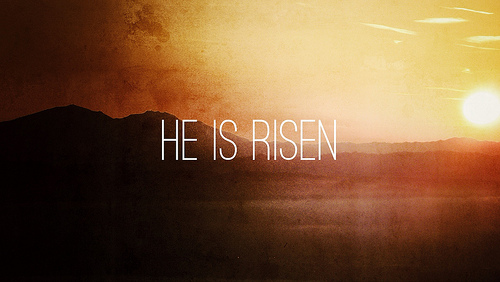
WHAT ABOUT JESUS’ RESURRECTION?

As we come to Easter Sunday there are two pieces I want to share that I hope will enhance your celebration of Jesus’ resurrection this year.

The first is the words of a worship song. One of the songs at the church we attended last weekend had such an impact on me I thought others would appreciate as well. I invite you to meditate on and savor these lyrics that emphasize the result of Jesus’ resurrection.

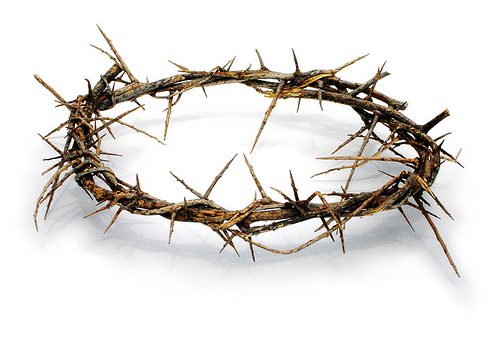
The head that once was crowned with thorns

Is crowned with glory now

The Savior knelt to wash our feet

Now at His feet we bow


The One who wore our sin and shame

Now robed in majesty

The radiance of perfect love

Now shines for all to see


Your name, Your name is victory

All praise will rise to Christ our King

Your name, Your name is victory

All praise will rise to Christ our King


The fear that held us now gives way

To Him who is our peace

His final breath upon the cross

Is now alive in me


The tomb where Life itself was laid

Was borrowed for three days

His body there would not remain

Our God has robbed the grave


Copied from Elevation Church website (http://elevationchurch.org/worship/)


The second piece is on a totally different level. It is a quote from an academic book I was reading this week that is worth reading even if we don’t totally agree with the author:

“It is notoriously difficult to deal with the resurrection in a historical presentation. Many historians do not think that consideration of the resurrection belongs to the study of the historical Jesus. After all, a person’s life begins with his birth and ends with his death. In addition, even if the resurrection happened, it lies beyond history and certainly beyond historical research. But what the historian can say with assurance is that the earliest Christians experienced something that they interpreted as seeing the risen Jesus. Not only does all the evidence point in this direction; it is difficult to imagine that the Jesus movement would have survived the horrendous and humiliating execution of its leader and the flight of the disciples unless the disciples had some experience that turned things around for them.”

(emphasis added) From Early Judaism: The Exile to the Time of Jesus by Frederick J. Murphy.

Share this post on social media and feel free to comment below.

photo credit: <a href=”http://www.flickr.com/photos/93084589@N03/8721313311″>He Is Risen</a> via <a href=”http://photopin.com”>photopin</a&gt; <a href=”https://creativecommons.org/licenses/by-nc-sa/2.0/”>(license)</a&gt;


ARE YOU KING OF THE JEWS?

What I hope will be a meaningful read as we come to Thursday and Friday of Holy Week this year.

The most dramatic and consequential questioning of Jesus took place during the hearings and trials He went through prior to His crucifixion. Actors have tried to capture the drama in a multitude of plays and movies ranging from small church youth-led Good Friday services to the big screen of Hollywood.

But the consequences were more important than the drama. For Jesus it meant His death on the cross. Of course He knew the reason He came was to die, but His prayer in the Garden of Gethsemane gives us insight into His inner struggle. In addition, the consequence of His death was an opportunity for us to have life, through the forgiveness of our sin and restoration of our status as children of God.

Context and Setting

The accounts of the night of Jesus’ arrest and trials, all the way through His resurrection and ascension, are in many respects the most difficult to harmonize in the Gospels. The trials before His crucifixion and His appearances after His resurrection are most challenging. John’s account of Jesus before Pilate is the most complete of the four with Matthew and Mark being in the most agreement about the entire ordeal. I suggest reading and studying one account at a time and not investing a great deal of time and energy in trying to harmonize everything.

In terms of the questioning of Jesus prior to His crucifixion, the questioning from Pilate was the final stage. Prior to appearing before Pilate Jesus went before Jewish authorities two or three times. It seems clear Jesus was first questioned informally and then later taken before the Sanhedrin (the formal Jewish council). Only John tells us that Jesus was taken first to Annas, the father-in-law of the high priest Caiaphas (18:13). After that He was taken “to Caiaphas the high priest, where the scribes and the elders had gathered” (Matthew 26:57).

Early the next morning the night’s questionings came to a climax. This exchange is also the high point of all that had transpired between Jesus and His critics during His final week.

The Jewish leaders were looking for evidence to charge Jesus so they could put Him to death. In the first part of the “hearing” they couldn’t get two witnesses to agree. Finally, two agreed about Jesus saying He was able to destroy the temple and rebuild it in three days. Yet even with the high priest challenging Him to respond, Jesus remained silent.

Finally, exasperated, the high priest challenged Him: “I charge you under oath by the living God: Tell us if you are the Messiah of God” (Matthew 26:63). By the things He had done and said, especially in recent days, Jesus had given enough reason for the high priest to ask the question. Matthew, Mark, and Luke all report Jesus’ answer a little differently; Matthew has Him saying, “You have said so” (Matthew 26:64a). As we will see later, this is very similar to the response Jesus would soon give to Pilate.

But the answer that brought everything to a head was what Jesus said next: “But I say to all of you: From now on you will see the Son of Man sitting at the right hand of the Mighty One and coming on the clouds of heaven” (Matthew 26:64b). It was a bold statement claiming a special relationship with God no human being could have. The high priest tore his clothes (a sign that blasphemy had been committed) and said, “He has spoken blasphemy! Why do we need any more witnesses? Look, now you have heard the blasphemy. What do you think?” (Matthew 26:65 and 66a). And all agreed Jesus was worthy of death.

The final note of context and setting is Matthew 27:1 and 2: “Early in the morning, all the chief priests and the elders of the people made their plans how to have Jesus executed. So they bound him, led him away and handed him over to Pilate the governor.”

Questioning Jesus and Considering His Responses

Since John’s account of Jesus before Pilate gives the most detail, we will use it in this part of our study. Pilate began the proceedings by asking the Jewish leaders what charges they were bringing against Jesus (18:29). These enemies of Jesus knew they didn’t have a charge that would stand up in the Roman court so their response was Jesus was a criminal. In the first of several efforts to remove himself from the situation, Pilate told them, “Take him yourselves and judge him by your own law” (18:31).

The leaders’ response was they did not have the right to execute anyone; this was the very reason they had taken Jesus to Pilate. The Roman government did not permit its subjects to convict and carry out the death penalty. That was in the hands of the local governor. The leaders’ problem was compounded in that blasphemy was a serious infraction for the Jews, but meant nothing to the Romans.

It was at this point that Pilate asked the key question. The question is identical in all four Gospels: “Are you the king of the Jews?” (Matthew 27:11; Mark 15:2; Luke 23:3; and John 18:33). The question is identical, but the recorded response of Jesus is not. Matthew, Mark, and Luke all have Jesus responding, “You have said so,” the same response Jesus had given earlier to the high priest. R.T. France notes this answer “is a qualified affirmative,” indicating yes to the question, but not in accordance with the meaning the questioner has in mind.20 In other words, Jesus was agreeing He was indeed a king, but not in the way Pilate was using the word.

John’s fuller account of the exchange between Jesus and Pilate bears out France’s interpretation of Jesus’ answer recorded in the other Gospels. John tells us Jesus’ responded with a question: “Is that your own idea, or did others talk to you about me?” (18:34). It seems pretty clear that Jesus’ accusers had set Him up ahead of time. Pilate responded, “Am I a Jew? Your own people and chief priests handed you over to me. What is it you have done?” (18:35)

The final part of Jesus’ response to Pilate is one of His best-known sayings: “My kingdom is not of this world. If it were, my servants would fight to prevent my arrest by the Jewish leaders. But now my kingdom is from another place” (18:36). He had a kingdom, but it was not like the world’s kingdoms. If it was His disciples would have fought for Him.

Only Luke tells us that at this point in the proceedings Pilate learned Jesus was from Galilee and sent Him to Herod (Luke 26:6:12). This was the second attempt by Pilate to opt out of dealing with Jesus. But Herod sent Him back to Pilate.

Pilate made two more attempts to get out of dealing with the charges and requests the Jewish leaders brought to him about Jesus. He brought up the custom of releasing a prisoner at the time of Passover and offered to release “the king of the Jews” (John 18:39). Instead they chose Barabbas. Pilate also repeated his view that Jesus was innocent by declaring, “I find no basis for a charge against him” (John 19:6b).

In John’s account Pilate also continued questioning Jesus, concluding with, “Don’t you realize I have power either to free you or to crucify you?” (19:10). In Jesus’ final words to Pilate He gave another bold and powerful answer: “You would have no power over me if it were not given to you from above. Therefore, the one who handed me over to you is guilty of a greater sin” (19:11). Jesus told Pilate the only power he had over Him was given to him by God. And even though Caiaphas (probably) was guiltier, Pilate was also guilty.

Wrap Up

Pilate was a conflicted leader who tried hard, but not hard enough. John tells us, “From then on Pilate tried to set Jesus free” (19:12a). But the Jewish leaders would not accept it. The final straw for Pilate was no doubt what these leaders had in mind when they first took Jesus to him. They told Pilate, “If you let this man go, you are no friend of Caesar. Anyone who claims to be a king opposes Caesar” (19:12b).

Even though I have known the account since I was child, and have heard it more times than I can count, I think one of the saddest verses in the Bible is John 19:16: “Finally Pilate handed him to them to be crucified.”

This is chapter 13 of my book Questioning Jesus: Considering His Responses. To learn more about the book, read endorsements, or order the book go to Amazon’s website:

http://www.amazon.com/Questioning-Jesus-Considering-His-Responses/dp/1517785855/ref=sr_1_3?ie=UTF8&qid=1455234806&sr=8-3&keywords=Questioning+Jesus

Feel free to share this post on social media and/or leave a comment below.

photo credit:

<a href=”http://www.flickr.com/photos/60532802@N07/5613765246“>Scourged 08</a> via <a href=”http://photopin.com“>photopin</a> <a href=”https://creativecommons.org/licenses/by/2.0/“>(license)</a>


WHAT ARE YOU ASKING FOR?

As we come to Palm Sunday, Good Friday, and Easter these next two weeks I have been reading Mark’s account of Jesus’ final trip to Jerusalem. Even though I have read it many times before, as well as preached from it, I was struck by the account of Bartimaeus in Mark 10:46-52.

Verse 46 tells us as Jesus, His disciples, and a large crowd were leaving Jericho there was a blind man named Bartimaeus “sitting by the roadside begging.” Like today, it was not uncommon in Jesus’ day for people to be at high traffic areas begging. What was uncommon was what Bartimaeus shouted when he heard that Jesus was coming by: “Jesus, Son of David, have mercy on me!” The title he used for Jesus indicated his high regard for Him.

Verse 47 tells us many in the crowd scolded and quieted him, but that only caused him to shout even louder. Hearing the shouting, Jesus stopped and instructed those with him to “Call him.” Now those who were previously quieting him began telling him to cheer up and get on his feet because Jesus was calling him. And Bartimaeus did not need to be told twice as he threw his cloak aside, jumped up, and went to Jesus.

Jesus’ question in verse 51 is what struck me: “What do you want me to do for you?” In his initial calls to Jesus he asked for mercy, but in response to Jesus’ question he was specific: “Rabbi, I want to see.” Then Jesus granted his request telling him in verse 52, “Go, your faith has healed you.” The account concludes with “Immediately he received his sight and followed along the road.”

The fact that Bartimaeus is one of the very few named that Jesus helped suggests to me this is an important account. I note the boldness, persistence, responsiveness, openness, and faith of Bartimaeus. And once he received his sight, Bartimaeus followed Jesus.

Hopefully you and I know who Jesus was and is even more clearly than Bartimaeus did. We know Him as Jesus; we know what the title Son of David means; and we look to Him as our teacher (Rabbi). We also know Him as our Savior and Lord.

I’ve been looking to Bartimaeus as an example and encouragement for me in prayer. In addition to the elements of praise and thanksgiving, one of my general requests lately has been for mercy. The Bible is clear that God is a God of mercy and I know that I need His mercy even when I am not aware of my need.

I am most intrigued by Jesus’ question: “What do you want me to do for you?” In his book Jesus: A Pilgrimage James Martin makes three statements that challenge me to do some serious thinking. First he suggests “Jesus sees something liberating in identifying and naming our desires.” Two paragraphs later he says “Notice that Jesus does not say, ‘Bartimaeus, just accept the way things are’.” Then the takeaway for me, “when we stand before God in prayer we should feel comfortable expressing our longings.”

In addition to asking the Lord for mercy, I also have a few specifics; in your prayers today what are you asking for?

Feel free to share your comments below and share these thoughts on social media.

photo credit: <a href=”http://www.flickr.com/photos/16210667@N02/16404623337″>Saying a little prayer for you</a> via <a href=”http://photopin.com”>photopin</a&gt; <a href=”https://creativecommons.org/licenses/by-nd/2.0/”>(license)</a&gt;